Teaching Dispositions: Cultivating Critical Hope in Community Literacy
Rachael Shah—University of Nebraska–Lincoln
Keywords: graduate education; community-engaged pedagogy; community literacy; reflection
ABSTRACT
Too often, those new to community literacy work naively overlook issues of paternalism, the violent aspects of literacy, and the deep legacies of racism that shape engagement. Or, as graduate students and novice community-engaged teachers learn about ethical challenges, they can become disillusioned and paralyzed. Mentoring others in community literacy therefore requires creating openings for critical hope, a disposition that blends a commitment to act with an unflinching awareness of harmful dynamics enmeshed in community literacy. Drawing on data from sixteen students in a graduate community literacy practicum, I introduce a heuristic that can be used to map orientations to critical hope and reflect on the ecological factors at play. As our field learns to better support those who are entering the unwieldy and energizing work of community literacy, creating space for reflection on individual ecologies of critical vision and commitment to action can help graduate students process their own evolving stances toward community-based literacy work.
CONTENTS
Moving across the Matrix: Factors That Shape Orientations to Critical Hope
Supporting Critical Hope Reflection
A HEURISTIC FOR CRITICAL HOPE: EXPLORING CRITICAL AWARENESS AND COMMITTMENT TO ACTION IN COMMUNITY LITERACY
At the midpoint of my first community literacy graduate course, I had a difficult conversation with a student after class. She had entered the class brimming with enthusiasm, especially about the mini-internship component of the course that placed students at local literacy sites—in her case, leading creative writing workshops inside a youth detention facility. But, at this point, she felt utterly paralyzed by all the ethical complexities involved in community literacy, unsure if she should or could continue working at her site. Like many scholars in literacy studies and composition, I am wary of students entering literacy sites with naiveté or paternalism, so I take a critical lens when teaching community literacy. Yet during that conversation, I saw how the relentless stream of hard questions about ethics and power can drain students of their sense of purpose in pursuing the teaching of literacy, and critique can easily bleed into cynicism and withdrawal. How can we mentor others through the process of grappling with the critical aspects of community literacy, while still leaving openings for a hopeful commitment to doing the work?
Foundational texts in literacy studies often illuminate the limits of literacy, throwing a bright, unforgiving light on the ways that literacy is entangled in oppressive ideologies. In the classic work The Violence of Literacy, for example, J. Elspeth Stuckey reminds us that literacy practices that appear neutral can inflict deep harm, especially on marginalized communities. Eric Darnell Pritchard picks up this theme as he draws on Black queer literacy narratives to theorize “literacy normativity,” describing how literacy is used to “marginalize, ostracize, and condemn people for their identities and other ways of being” (31). Literacy education is often deeply shaped by trajectories of settler colonialism, racism, heteronormativity, xenophobia, and other structures of marginalization (Baker-Bell; Patel; Wan). Not only does literacy have the potential to harm, but its benefits are not as simple as popular interpretations would have us believe; scholars have challenged the myth that literacy, by itself, has transformative impacts independent of its social context and use (Graff; Street). Passing a reading test or acquiring digital literacy does not grant immunity from the multifaceted forms of oppression that often shape people’s lives. And in fact, as Kirk Branch reminds us, tying literacy education to hopes like economic advancement, citizenship, or critical thinking can cause further harm because it puts the focus on illiteracy rather than on the violent social disparities that structure our world. So, literacy scholars and practitioners are caught in a bind, as we have learned to distrust the hopes of literacy even as most of us engage in literacy education—and mentor others into this work.
Community engagement, like literacy, is also rife with ethical complexities and constraints. Linda Flower traces the problematic “logics” that often sustain university involvement in local communities, including the logic of “cultural mission,” a deficit-based view of communities that imposes white culture, and “technical expertise,” a hierarchical perspective that positions communities as passive recipients of university expertise. These university-centric logics can lead to real harm for communities engaged in partnerships with higher education, and Paula Mathieu details stories of unfulfilled commitments, useless projects, and paternalistic interactions. Vani Kannan, Ben Kuebrich, and Yanira Rodríguez explore how even community partnerships grounded in progressive rhetoric can have oppressive outcomes, and they argue that community engagement often primarily serves the corporate and militaristic goals of universities.
Ethical concerns like these must be explored by university representatives who will be entering community literacy sites, as the ability to see problems is the prerequisite for addressing them. As academics, we are well versed in the art of critique. But what we are perhaps less prepared for is the work of cultivating hope, commitment, and action. As Paul Feigenbaum notes in Collaborative Imagination: Earning Activism Through Literacy Education, an academic “perfect standard” of critical consciousness and literacy activism can lead to debilitation, as students and scholars may avoid attempts at making change because they cannot live up to this idealized standard.
This problem raises the question of how to support graduate students and novice teachers in developing the dispositions needed for community-engaged literacy work, especially as engaged graduate education continues to expand. In rhetoric and composition, “Community Literacy” is common in graduate curricula (Carlo and Enos), and several scholars have published discussions of graduate community literacy seminars, often co-authored with the students in these seminars (Bowen et al.; Fero et al.; Weinstein et al.).i Work has begun to trace the long-term impact of teaching community-based writing classes on graduate students (Druschke, Bolinder, Pittendrigh, and Rai) and map the competencies involved (Doberneck, Bargerstock, McNall, Egeren, and Zienek). Yet at the same time, several graduate students have published narratives of the complexities of retaining a commitment to hope and action in community literacy in the light of ableist, neoliberal, and hierarchical structures (Hizer; Hubrig, McWain, Meade, and Shah; McClantoc and Hubrig; McCool), and the body of scholarship built around how to equip graduate students for engaged work is relatively thin (Harris; O’Meara).
There are several rich heuristics that aim to push participants toward a more critical stance in community engagement, such as the “Critical Service Learning Reflection Tool,” developed out of Duke University (Stith, Anderson, Emmerling, Sikes, Clayton, Malone, and Bringle). This tool asks readers to rate their participation levels in specific critical practices, organized around five themes— “Authentic Relationships, Equitable Classrooms & Cognitive Justice, Reckoning with Systems, Social Change Skills, and Redistribution of Power” (5). For example, under “Redistribution of Power,” participants are asked to rate the level to which they build shared models of leadership in the community partnership that extend beyond organization leaders and include multiple marginalized perspectives. After rating each practice, participants are encouraged to focus on one area they rated as “somewhat” part of their practice to target for enhancement. Another example of a heuristic for fostering critical awareness, the HEADS UP model, was developed by Vanessa de Oliveria Andreotti, to be used especially in the context of global community engagement. This heuristic, through its acronym, invites participants to reflect on the complexities of “Hegemony,” “Ethnocentrisim,” “Ahistoricism,” “Depoliticization,” “Self-congratulatory and Self-serving attitude,” “Uncomplicated Solutions,” and “Paternalism” (Andreotti 108). These guided reflection tools are powerful in leading readers to consider the various facets of criticality that can enable anti-oppressive action in community engagement.
I wonder, also, how heuristics might be more explicitly used to help graduate students navigate the interplay between these critical stances and hope. As Kari M. Grain and Daren E. Lund write in “The Social Justice Turn: Cultivating ‘Critical Hope’’ in an Age of Despair,” the shift toward justice-oriented community engagement
is premised on, and can be aided by, the necessary tension between criticality—of privilege, charity, hegemony, representation, history, and inequality—along with a hope that is neither naïve nor idealistic, but that remains committed to ideals of justice, reflexivity, and solidarity. The criticality and hope that underlie the social justice turn in service-learning cannot be disaggregated but rather must work in tandem with one another at all times. (Grain and Lund 51)
Understanding the ways that criticality and hope work in tandem—and opposition—with each other is complex, and intentional support may help graduate students better recognize and respond to the push-pull of this tension in their own contexts.
This article, then, offers a heuristic that explicitly looks at the interaction between hope and criticality in community literacy, along with the factors that influence how a person might navigate the tension between them. The heuristic is intended to be used as a guided reflection tool that can support those who are involved in community literacy work—and especially who are mentoring others in this work—in better conceptualizing critical hope and maneuvering within critical hope dynamics.
The heuristic emerges from a study of my graduate community literacy seminar of 16 students during the COVID-19 pandemic. This class is generally taken by both masters and PhD students in English, including mostly full-time students focusing in Rhetoric and Composition, but also some literature and creative writing graduate students, local secondary teachers, and undergraduate pre-service English teachers. The course introduces key scholarly conversations in literacy studies and community writing, in addition to placing students in “mini-internships” with local literacy organizations for two to four hours a week. These mini-internship sites are chosen in close consultation with me, given the student’s and the organization’s interests, capacity, availability, and prior relationship (when applicable). Sites range from youth slam poetry teams to English language classes for refugees, environmental literacy organizations, writing classes inside detention facilities, and more. Students regularly write reflections that connect the scholarly conversations of the class with their internship, and the first unit is devoted to the complexities of entering community literacy sites. The major seminar project is open-ended, and has included academic conference presentations, community-engaged class or research project designs, and/or deliverables for the partner organization.
With IRB approval, and with the support of a SoTL (Scholarship of Teaching and Learning) program at my university, I studied the spring 2020 section of this graduate class.1 I collected texts from the class that were relevant to critical hope, such as certain reading responses and collaborative google docs, and each month I invited students to participate in a short reflective freewrite, selecting words from a list to describe their disposition toward community literacy (e.g. wary, committed, excited) and freewriting about their choices. Near the end of the semester, I did a first round of coding for themes, and as I did so, I began trying to sketch out a figure that represented my developing understanding of critical hope based on student insights. I presented a draft of this figure, along with a presentation of emerging themes, to my students at the final class session for their use as a reflection tool and for their feedback, in the spirit of the community-based participatory research methodologies we had studied during the class that intentionally blur the lines between researcher and researched.2 Students hosted their own peer-led interviews3 using this figure as a heuristic to reflect on their current disposition toward critical hope, and they shared their suggested revisions to the tool. I transcribed these interviews, loaded them into Dedoose qualitative research software alongside the existing data, and coded for themes again, informing the version of the reflection tool and discussion presented here.4
In this article, I introduce a heuristic for descriptively—not prescriptively—mapping orientations to “critical hope,” a sensibility that blends a commitment to act with an unflinching awareness of harmful dynamics enmeshed in community literacy. After theorizing the concept of critical hope, I offer an overview of the critical hope matrix, discussing its four main quadrants and troubling its categories with examples from student data. Next, I further draw on student insights to examine the section of the figure that encircles the quadrants: factors that influence movement across the matrix. The article concludes by offering concrete recommendations for community literacy courses, graduate mentoring, or professional development, exploring how the critical hope matrix can be used as a tool for classroom reflection or individual faculty practice, and raising questions to consider as our field learns to better support those who are entering the unwieldy and energizing work of community literacy.
THEORIZING CRITICAL HOPE
A deep understanding of hope for the purposes of literacy work requires moving beyond colloquial understandings of the term. Often, hope is positioned as naïve, a stance that requires turning a blind eye to negative evidence, and passive, a feeling that carries with it no expectation of concrete action. On the contrary, the conception of critical hope that frames this project requires an honest grappling with the trajectories of oppression that mark community literacy work and commitment to action in light of these challenges. In short, hope involves both critical awareness and commitment to action. In this section, I explore each of these components in turn.
“I am hopeful, but I am not naive” Cheryl Glenn says simply in Rhetorical Feminism and This Thing Called Hope (212), making the case for clear-eyed, critical awareness as part of a stance of hope. Indeed, she lays out a devastating overview of the bleakness of her current political moment in the first Trump presidency, and in the same breath, she calls for hope. For Glenn, hope is not incompatible with hard circumstances. Cornel West explains how hope arises not from ignoring but engaging difficult moments, theorizing his concept of “tragicomic hope”: a “hard-fought way of life” that calls for moving forward even in light of dehumanizing hate and oppression (19, 23). Keith Gilyard describes West’s tragicomic hope as an “indomitable, keep-on-pushing sensibility reflected in the high plateaus of African American music and its organic connection to the black freedom struggle” (78). Tragicomic hope, then, requires not blind optimism but a deep journey into the painful and oppressive structures that shape our world. West gives illustrations from civil rights activists to ground hope in “the essence of the blues: to stare painful truths in the face and persevere without cynicism or pessimism” (24). Hope is not a synonym for rosy optimism—it involves deep, unsettling, and honest examination of pain.
Hope therefore requires critical awareness, an approach that seeks to identify, critique, and resist oppressive power dynamics,in the spirit of critical theory and critical pedagogy. As Max Horkheimer, one of the foundational critical theorists of the Frankfurt School, argues, critical theory “never aims simply at the increase of knowledge as such,” but rather aims at forwarding human “emancipation” (2456). This definition of “critical” is also present in theoretical families like Critical Race Theory (Bell; Delgado and Stefancic) and LATCrit (Delgado Bernal), as well as pedagogical approaches like critical pedagogy. As Peter McLaren writes, critical pedagogy “engages students in analyses of the unequal power relations that produce and are produced by cultural practices and institutions (including schools), and it aims to help students develop the tools that will enable them to challenge this inequality” (qtd. in George 92). The critical component of hope involves an unblinking look at the problematic dynamics and painful aspects of community literacy work, with the goal of identifying pathways for change.
Yet critical hope does not stop with reflecting on problems or discussing tools for change. As Paula Mathieu argues in Tactics of Hope: The Public Turn of Composition, hope “combines critical reflection with action” (18). Mathieu explains that hoping is fundamentally different than wishing, because hope requires taking on “risk and responsibility” (17). Wishing that someone might call or wishing that the rain might let up before it’s time to travel to campus requires no responsibility to say or do anything to bring about the desired end. Yet Mathieu’s understanding of hope, informed by Marxist utopian theorist Ernest Bloch, “is to look critically at one’s present condition, assess what is missing, and then long for and work for a not-yet reality, a future anticipated” (19). In community literacy, hope requires acknowledging the problematic and insufficient nature of our work, but then acting out of this awareness. It requires moving forward in meaningful action.
Hope therefore involves a commitment to action. By action, I mean concrete steps in community literacy toward what Carmen Kynard calls the work. She describes the work as our deeper, justice-oriented calling, and differentiates the work from the job, the basic duties of our academic appointment, or the hustle, the professionalization moves, attuned to white norms, required to move ahead in the field. Kynard suggests that it is easy for academics in rhetoric and composition or literacy studies to confuse the work, the job, and the hustle, and she calls those of us pursing community literacy to remain oriented to doing the work. Important here is her focus on doing in the phrase doing the work—the work requires a responsibility to act. Such a commitment to action therefore brushes up on questions about agency, a contested and complex term. Carl G. Herndl and Adela C. Licona remind us that agency is not a stable sense of power that people can possess or lose. They argue that “agency is not an attribute of the individual but the conjunction of a set of social and subjective relations that constitute the possibility of actions” (133). As they explain, agency is rooted in kairos, or “social location in time and space,” in and out of which people move as they experience opportunities to act. Agency is therefore constrained but still possible, as particular situations and structures create time-bound moments of potential action. In other words, a commitment to action is not a simple belief held or lost by an individual graduate student in a community literacy seminar—a sense of agency is enabled and constrained by the tangle of actors and structures that shape the classroom, the community literacy site, and the surrounding world. A critical awareness of the constrained nature of agency is important for moving beyond a naïve notion of community literacy, developing resilience in light of inevitable limitations, and reflecting in generative ways on the possibilities for doing the work. In short, the critical awareness and commitment to action components of hope work together, even as they present a tension.
The question of how to work in the tension between critical awareness and commitment to action is central to community literacy work for teachers and community participants. Patrick Berry offers a compelling story of how Juan, a member of a prison literacy class, holds this tension. During a cover letter writing exercise, Juan articulated an awareness that the structures surrounding the criminal justice system would limit his future employment opportunities, and that he and many of his peers would be “flipping burgers” regardless of the education in professional business writing they were receiving (Berry 24). In other words, Juan had a critical awareness of the limitations of literacy instruction. Yet he was also a dedicated participant in the writing class, saying, “Anybody who is able to obtain higher education while incarcerated will testify that it does something to you” (24). As Berry reflects, “[Juan ’s] complex understanding of what writing does and does not do demonstrates a hopeful and sometimes playful yet critical relationship with literacy that resists easy classification. Despite barriers and despite fear, he continued to write with the hope of making a difference in his own life and the world” (24). In short, Juan had critical hope. In some cases, graduate community literacy programs can foster this same kind of critical hope that Juan embodies so richly.
At the same time, sometimes graduate literacy education does not—and should not—lead to a critically hopeful engagement in community literacy initiatives. In the next section, I will introduce a matrix for mapping critical hope, but before I do, I want to emphasize that the matrix is intended to be descriptive rather than prescriptive, useful for understanding an orientation to critical hope in community literacy at a particular moment rather than an implicit argument there is a “correct” place on the matrix (one that most embodies a hopeful commitment to action and a critical stance) that students should be aspiring to. This descriptive framing of critical hope is important, because I want to explicitly trouble two assumptions. First, I am wary of the assumption that successful literacy programs necessarily realize our hopes (for citizenship, economic gain, liberatory personal expression, critical consciousness, and all the other expectations that weigh on literacy programming). As I touched on above, literacy scholars have long pointed out this is a deterministic myth (Graff) that can often serve to draw attention away from structural problems (Branch), and the actual program can do more harm than good (Pritchard). And second, I want to question the assumption that it is always our role to help graduate students and ourselves sustain that hope. Drawing on queercrip frameworks, Keshia McClantoc and Ada Hubrig highlight the dangerous nature of institutional expectations that can be placed on graduate students to perform community literacy work. Ada, for example, describes sobbing from shame in their hospital bed when they missed a community writing meeting for unhoused individuals due to a medical situation. Implicit pressures to achieve a “successful,” critically-aware community literacy partnership—pressures which often function decontextualized from graduate student factors like disability, economic precarity, mental health, and labor concerns—can create real harm. This is why the matrix that follows is designed to help individuals notice the dynamics and contextual factors that relate to their orientation to critical hope in community literacy, and provide space for reflection, rather than pressuring students to inhabit a particular quadrant. Often times, the dynamics that influence a graduate student ’s orientation to critical hope in community literacy are experienced but not named or discussed in an academic setting, and one aim of this matrix is to provide space for these discussions.
CRITICAL HOPE MATRIX
The concept of critical hope that I theorize in this article can be portrayed as a figure, the critical hope matrix, to illuminate some of the ways that people interact with the concept. The critical hope matrix includes two axes that align with the two components of critical hope discussed in the previous section: the y-axis indicates critical awareness, and the x-axis signals commitment to action (see figure one). Intersecting these two axes creates four quadrants that represent some of the common orientations to critical hope, with different positions within each quadrant representing varying proximity to the axes. Here, I explain the matrix, drawing from student insights to illustrate each of the four quadrants.
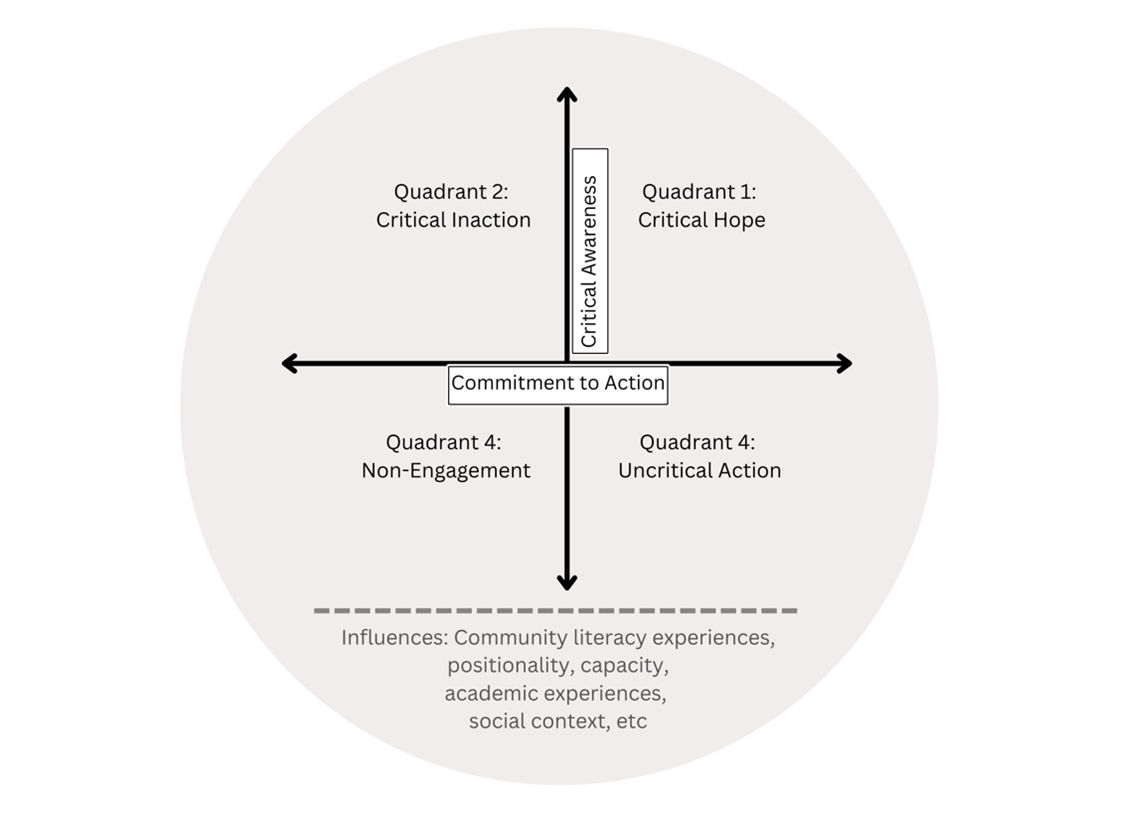
Fig. 1. Critical Hope Matrix
Quadrant one is characterized by both high commitment to action and high levels of critical awareness: this is the stance of critical hope. People with this orientation have a rich sense of the problems and insufficiencies of community literacy, but they are still invested in being involved in this work. They reflect deeply on the ethical complexities of their work, identify problematic dynamics as they arise, and continually revise to keep moving forward. One student succinctly expressed this stance at the end of the semester, writing, “Community Literacy and working with communities takes a lot of critical work and self-awareness. It ’s difficult, but certainly work worth doing.” Well versed in critical theories of literacy, she identified a strong commitment to continue to work with a literacy initiative she was coordinating.
Quadrant two, with high critical awareness but low commitment to action, is characterized by critical inaction. People in this quadrant may be able to identify all the problematic aspects of community literacy work, but—for multiple possible reasons—do not attempt to engage in the work themselves. This quadrant may provide an armchair critic position from which to criticize the work of colleagues who are involved in community literacy and build a rationale for why academics in English studies should not participate in local literacy ecologies, especially for those in the upper left corner of the quadrant. In other cases, people in this quadrant may be closer to the y-axis: they may want to engage in action, but they are so overwhelmed by the potential ethical problems that they have trouble moving toward doing the work—this stance expresses itself as analysis paralysis. Or, people may be hovering at the edge of crossing over the y-axis into action, as they may be new to a community or new to community literacy work, with enough critical awareness to know that it is important to listen and learn before attempting to participate in community literacy programs. They may also hold a rich critical awareness and interest in acting in the future, but be limited by barriers to agency, such as an unsupportive advisor or childcare responsibilities, that make it difficult to act. One student who sustained a particularly strong critical lens throughout the semester illustrated some of the potential dynamics of this quadrant. As she wrote in her first freewrite, “I ’m critical of my own desires to see an impact that one semester will make for other people.” And later, she expressed hesitance to pursue community literacy work in the future, especially through community-based pedagogy, saying, “I am cautious that especially in [Name of City], I don’t have deep community connections and I am pretty aware that myself—and to project a little to [my] students—that we could do a little more harm than good.”
Non-engagement, with both low commitment to action and low critical awareness, is the defining stance of quadrant three. People in this category likely have little experience with community literacy work. They may have not have thought much about community literacy, perhaps because they have not been exposed, they are not interested, or they have other pressing concerns. Or, they may have been involved in the past but are not currently invested. The inaction stems less from concerns about the ethical challenges of literacy work, and more from lack of interest or attention. A wide variety of factors, from mental health challenges to lack of access to discussions of community literacy, to “publish or perish” pressures related to the academic job market, to pressing personal and professional interests elsewhere, can lead to a position within this quadrant. As one student explained, before the class, “I had done so little reading and so little thinking about community writing and community literacy besides just, ‘Well, I don’t know how to do that.’”
And finally, quadrant four combines high commitment to action with low critical awareness, producing uncritical action. Those operating out of this quadrant may have sincere investment and even substantive experience in community literacy work, often fueled by religious or civic commitments to the common good, but they may not yet be able to offer a robust articulation of the problematic power dynamics and limitations of community literacy. As one student wrote in an early freewrite, she had been involved in language and literacy work in communities, but she hadn ’t yet theorized these projects as literacy work—they were “just jobs.” Another student, in a closing reflective interview, explained that she had begun the class with significant on-the-ground experience in community literacy through writing outreach programs in urban schools, but did not yet have a critical lens: “I had a couple of Spidey senses, but no real critical apparatus.” The uncritical action quadrant is bolstered by common cultural discourses that celebrate community volunteerism and frame literacy as a solution to poverty. For many who begin in this quadrant, a graduate community literacy seminar or engaged pedagogy professional development workshop may call for significant changes to their lenses on literacy work.
Taken together, the four quadrants of the critical hope matrix offer a map for tracing common orientations to community literacy work. It is important, however, to emphasize that this matrix is an obvious simplification of very complex dispositional characteristics, so these quadrants do not represent clean categories—in practice, one ’s orientation to this matrix is often moving and difficult to define, and the quadrants blur. One person ’s experience of a particular quadrant may be markedly different from another person ’s, as the contextual factors that shape orientation to community literacy—such as race, personality, and the specifics of the community literacy site—play a significant role. I also want to be careful here to stress again that this matrix is intended to be descriptive and reflective rather than evaluative, and I do not want to associate value judgements with locations on the matrix, with the exception of the “Uncritical Action” quadrant, given the potential for harm. In short, critical hope is not the “best” quadrant in many cases. Many valid and important reasons exist for identifying with the other quadrants. For example, a graduate student new to a city may appropriately acknowledge that they need to spend time learning about the context before committing to action, a lecturer may decide to step back from a community literacy initiative that is following problematic practices, an emerging scholar may focus their interests on making justice-oriented change in academic conversations rather than local department or community initiatives, a graduate student facing systemic challenges may need to put all energy toward surviving the academic environment, or a new parent may need to dedicate all available time on balancing childcare with academic responsibilities.
In addition, this matrix is designed to function not as a set framework, but as a sort of manipulative, like the objects given to young students to help them explore concepts such as density or fraction—something to play with, something that can be twisted, flipped, or broken apart as needed to foster understanding. I saw this kind of thoughtful manipulation of the model in one graduate student ’s interview, when she invented her own blended quadrant while talking about a key learning moment in the class. Referencing Deborah Brandt ’s definition of literacy sponsors as agents who enable or suppress literacy “and gain advantage by it in some way” (166), the student shared that she was familiar with literacy agents who did not have good intentions, but she hadn ’t previously “thought so closely about the interests of ‘the good guys’” such as non-profits, “and how those could still shape the form that literacy work takes.” Relating this learning moment to the critical hope matrix, she shared that Brandt ’s concept prompted her to want to “do more research and unpack the ghosts in the closets” at her internship non-profit—which she playfully identified as “armchair critic action.” By reimagining the armchair critic stance as an active one, rather than emblematic of the “critical inaction” quadrant where it was placed, the student demonstrates the malleability and inventive potential of the critical hope matrix.
With these nuances in mind, I turn next to a discussion of the circle that surrounds and permeates the four quadrants, a section of the figure that indicates the contextual factors that shape orientations to critical hope.
MOVING ACROSS THE MATRIX: FACTORS THAT SHAPE ORIENTATIONS TO CRITICAL HOPE
The circle surrounding the quadrants in the critical hope matrix, explicitly dedicated to contextual factors, is intended to help others identify and reflect on the influences that shape their own pathway through critical hope dynamics. Data from student reflections and interviews reveal the complexity of these pathways. When designing the study, I anticipated that a rough majority of students might follow a common “plot” in their orientations toward critical hope, perhaps starting in the non-engaged or naïve action quadrant, veering into the critical inaction quadrant (an armchair critic or analysis paralysis stance) as we discussed critical readings on literacy and the honeymoon period at the internship site ended, and then rounding out into critical hope as they learned strategies for moving forward in spite of challenges. My visual map for the anticipated vision of their path was similar to the “Common Ups and Downs of the Decolonizing Journey” figure presented by Sharon Stein et al.,ii which begins with “excitement,” and a line that suddenly spikes upward, along with the words “promises of safe, straight-forward, easy solutions,” aligning with the naïve action quadrant (8). Then, Stein et al.’s line takes a steep turn down, with descriptors “overwhelmed and immobilized due to disappointment, depression, disillusionment, frustration, sense of hopelessness” matching the critical inaction quadrant (8). Then, the line climbs up partially again, followed by small dips up and down to communicate a continued pattern forward, alongside words that include “stamina,” “discernment,” and “comfort with uncertainty,” matching what I view as critical hope (8). I carefully incorporated readings, activities, and assignments into the class that I hoped would support this common journey.
However, the data revealed that students began and ended all over the matrix, and they moved in different directions; while some did follow my anticipated path, many did not. Figure two below maps the trajectories of the students who completed all of the major reflective checkpoint assignments, demonstrating the individualized nature of critical hope pathways.
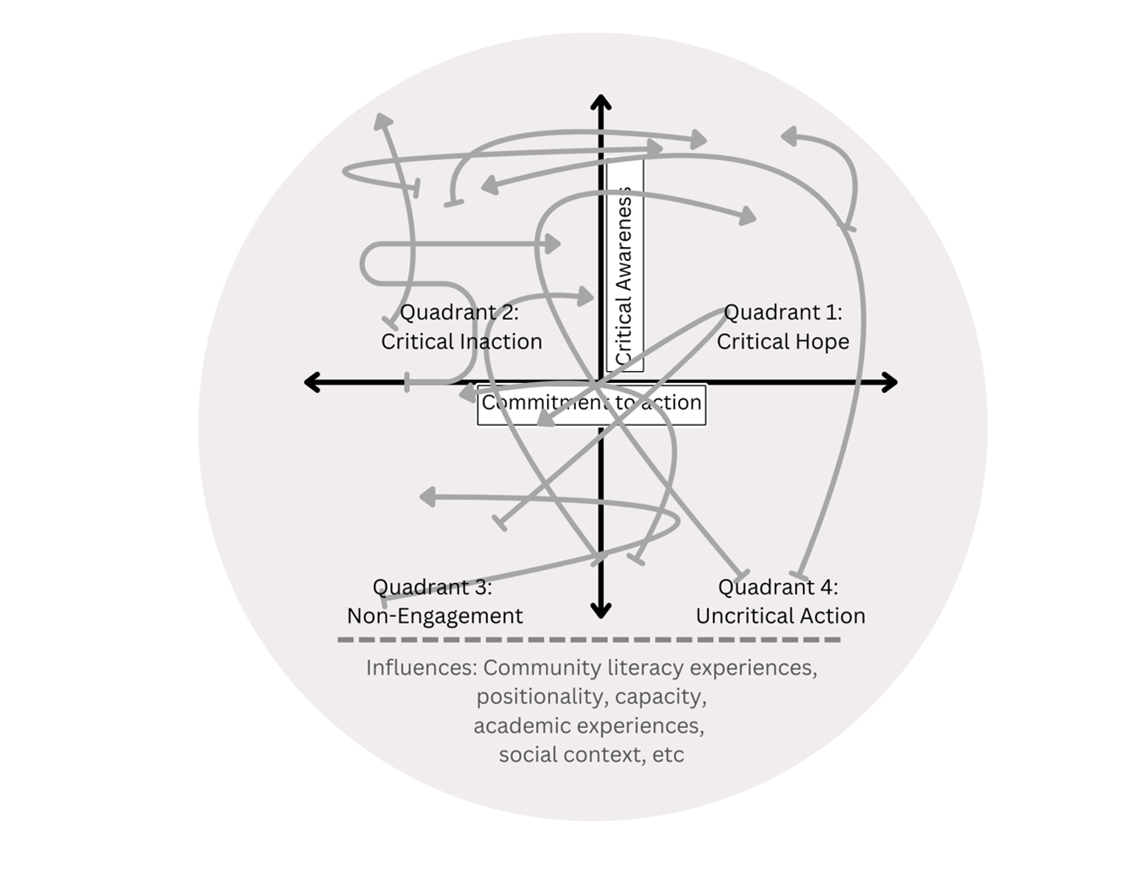
Fig. 2. Student Trajectories on Critical Hope Matrix
When asked about the factors that impacted critical hope trajectories, students sometimes referenced pedagogical choices, but often they discussed external influences. In particular, data collection for this study occurred during the spring of 2020, when the pandemic first upended normal daily life and shut down face-to-face internships at community literacy sites, and COVID-19 ramifications played a significant impact in students’ developing understandings of critical hope. At first glance, it may seem that data collected during the pandemic would not be useful in understanding dynamics in more typical moments of critical hope dynamics. However, the discussion in one of the peer-led interviews shed light on how the pandemic actually served to clarify common dynamics. The students were discussing possible changes to the matrix to better account for the fact that they wanted to act at their community literacy sites but were unable to because of the pandemic shutdown. One student suggested a new matrix space to indicate “limbo” or “pause,” but the other student argued that this change might be “covid-specific,” wondering how often that space would be used outside of the current circumstances. In response, the first student referenced a peer’s internship, in which planned activities to launch a zine and a youth advocacy writing workshop were stopped due to a series of institutional roadblocks. She continued, “Covid took away agency from a lot of people at once. And institutional forces take away agency from a lot of people all at once, too.” In short, COVID set in sharp relief dynamics that are always present, though sometimes concealed: critical hope is not a matter of internal enlightenment, but rather it is deeply shaped by external forces. One student illustrated this when discussing her critical hope trajectory, describing how she was “pushed” into a different quadrant. As this study demonstrates, the development of critical hope occurs in a complex web of interacting environmental factors, and perhaps the most important mentorship strategy is therefore to support novice community literacy educators in understanding and responding to their own ecologies. In what follows, I explore some of the influences highlighted by my students in their reflections. The bottom of the critical hope matrix explicitly acknowledges these influences, as the grey circle symbolizes the way these influences permeate how critical hope is experienced, with the goal of encouraging others to name and reflect on the influences that are acting on them.
The influences that students referenced most frequently when discussing their orientations to critical hope was their community literacy internship—their on-the-ground community literacy experiences. All students were placed at community literacy sites that matched their interests, with weekly participation at the site. Students often described their critical hope position in terms of what was occurring at their internship site, from the challenges of working with a resistant older participant in a language class to the invitation to join a community member ’s family for dinner, underlining that critical hope is most fully explored not through readings or discussions, but through experiential learning. Yet, as many in community writing have identified, the power of engaged pedagogy occurs alongside its unpredictability—community literacy is a stochastic art, like medicine, as outcomes are uncertain even when best practices are followed (Clifton). An instructor or mentor may guide students to particular organizations or recommend certain approaches, but ultimately, each community literacy partnership experience will unfold in its own unforeseeable way. As one student reflected, “A search for critical hope is such a personal thing. It’s largely dependent on how a person’s internship goes, and both the student and the teacher of this class have very little control over that student ’s experience with their internship.”
The COVID-19 pandemic underlined both the power and the unpredictable nature of experiential learning in community literacy. When the pandemic hit unexpectedly, the class internships were stopped entirely or dramatically altered to operate virtually, and many students’ ’ critical hope trajectories took a sudden turn. For example, one student who was previously operating in the critical hope quadrant was “ghosted” by her site when trying to move her internship online, a response she fully understood, but it still felt “disappointing” and led her to be “disengaged.” She was one of several who followed a similar turn toward non-engagement (quadrant three) as planned literacy activities were sidelined and attention understandably shifted elsewhere. Yet another student was inspired by how she saw her site creatively adapting to respond to COVID, which led to a deeper sense of critical hope (quadrant one) as she wanted to be involved in their efforts. A different student identified the pandemic as pulling him out of analysis paralysis (from quadrant two toward quadrant one), as it limited his options for future pedagogical partnerships into a manageable list. The pandemic upended the critical hope trajectories of many students, as their understanding of community literacy was so enmeshed with the experiential learning at their site.
Even outside of dramatic shifts due to COVID, however, the internship sites had a powerful influence on students ’ critical hope, a finding that aligns with Lauren Marshall Bowen and her graduate students ’ discussion of the broad impact of direct community engagement experience in a graduate community literacy seminar. Particularly important to critical hope development was the extent to which the organization modeled critical hope. One student wrote about being energized by the ways she saw her site resist problematic power dynamics in community literacy, as her organization used strategies such as allowing the youth participants to lead. Working at a different site, another student wrote, “The organization I worked with has an important goal, but their engagement tactics were difficult for me, because they were doing a lot of the things we learned to be critical of in this class,” such as imposing programming without local collaboration or input. Working with an organization that does not share a critical lens on troublesome dynamics in community literacy can offer an opportunity to develop strategies for pursuing critical hope within restrictive institutions, but this situation does make moving toward quadrant one, critical hope, much more difficult. In short, students encountered a wide variety of internship circumstances, and their reflections indicate that a student ’s personal experiences with community literacy play a key role in the ecological web that impacts the development of critical hope.
A second factor in critical hope development—interacting with all the others—is student positionality. COVID-19 highlighted vast disparities in how students experience community literacy work and graduate school more broadly, as students contended with challenges such as sudden family caretaking responsibilities, lack of internet connection in a rural living situation that necessitated doing remote work in a library parking lot, and mental illness severely exacerbated by the pandemic. These factors, linked to identity markers such as gender, class, and dis/ability status, strongly shaped how students approached critical hope during the pandemic. For example, one student wrote, “As someone who deals with multiple mental health issues in normal times, the pandemic has really done a number on me. It ’s hard to maintain that agency aspect when I see 26 million people losing their jobs, worrying about homelessness, starvation, so many deaths.” The pandemic made the impact of student positionality more obvious, because it intensified differences, and it led students to reveal positionality markers more publicly while negotiating emergency accommodations and support.
Yet identity factors were inflecting the dynamics of critical hope throughout the semester. For example, one student identified herself as positioned in the critical hope quadrant and shared, “I don’t really consider myself a person of naïve action, because as someone who’s had people try to ‘save’ me, as a poor rural white person who was constantly told I was too illiterate, I don’t think I’ve ever had that approach to community literacy.” This student’s raced and classed background offered its own lens, built through personal experience, that granted insight into the complex nature of literacy engagement and positioned this student on the higher end of the criticality axis. In different ways, orientation to the “commitment to action” axis was also influenced by identity factors. At the beginning of the semester, one student wrote, “I’m apprehensive because I tend to be an introverted, bookish, homebody and getting out to meet new people and go to new places when I don’t feel super-prepared or knowledgeable is very stressful and draining for me.” The action component of critical hope was dauting to this student because of the new relationships required. Similarly, a peer reflected in her closing freewrite, “The armchair critic space [quadrant two] is easier for me to dwell in, because as an introvert it’s very difficult for me to make the necessary normal human connections for community work, even though I can apply that critical lens. I have moved closer to the critical hope space, and definitely aspire to be there, but with my social anxiety, I know I have a lot of work to do to fulfill that agency.” As these two statements illuminate, a high position on the “commitment to action” axis demands much more from some students because of identity factors. Student identity predisposed students to begin their semester in various places on the critical hope matrix, and these identity factors exerted different gravitational pulls as students moved across the matrix.
Positionality interacts intensively with the other factors, such as experience through a literacy internship, that influence critical hope. For example, one student selected the word “cautious” to describe her orientation to community literacy, explaining that both she and her co-teacher at her internship site were “white, 20-somethings, and American citizens,” while most of the students in the class were people of color who did not speak English as a native language. She had enough of a critical lens to recognize the complicated nature of interacting across difference in literacy settings, like English language classes, that have historically functioned as sites of assimilation and white saviorism, leading to hesitation about what a commitment to action might ethically look like in this space. Conversely, another student discussed how the opportunity to return to a site where she had once been a literacy learner herself deepened her investment. Graduate students ’ positionality relative to community members at their literacy site shaped their thinking about critical hope, one of many ways that identity influenced their dispositions. Similarly, Michael Blancato, Gavin P. Johnson, Beverly J. Moss, and Sara Wilder found in their study of community-engaged teachers, including several graduate student teachers, that the positionality of instructors played a pivotal role in shaping approaches to teaching a community literacy class, as it impacted the ways that teachers connected with community sites. In particular, they highlighted the role of race, institutional status, creative interests, and community relationships in impacting course design. These authors argue that those who teach or mentor others to teach engaged writing classes should consider instructor positionality as a central and urgent topic of reflection, as it so powerfully influences ways of imagining community literacy work—a call that my study echoes, as well.
Also strongly shaped by positionality, capacity emerged as another factor that students identified when explaining their critical hope trajectories. Students wrote about their capacity—in terms of time, energy, emotional labor, and other resources—to take up the work of critical hope. Capacity concerns were foregrounded by COVID-19, as the pandemic often limited the bandwidth students had for community work. In a final interview conversation, one student discussed how reckoning with the pandemic had sapped much of her energy. She reflected, “I ’m personally tired. It ’s not that I ’m not hopeful. It ’s not that I don ’t want to be critical. It ’s my brain hurts when I think about it [the pandemic].” Her peer interviewer responded, “I think that you have critical hope fatigue.” In a similar vein, another student wrote, “While it would seem that many people have more time to dedicate to projects [because of the shutdown], even those of us with fewer adjustments (like what to do with kids, ailing family members, etc.) might be struggling finding the mental space to take on new projects, let alone finish old ones.” Several students also wrote about the emotional toll of worrying about community members at their literacy sites who were facing the pandemic from positions made precarious by racism, poverty, and language barriers. As COVID brought to light, capacity for community literacy work involves not just time, but emotional energy. A third student explained in her interview, “Especially with covid, I’m trying to be really careful about how I give my time out and trying to make sure that when I do it, it’s in really meaningful ways. But I do also feel like I’ve got some connections with communities here where I can do meaningful work.” The COVID-19 pandemic made time and emotional energy even more precious resources for many, leading to important reflections about what role community literacy might have in students’ lives, and what kind of “commitment to action” might be feasible.
Capacity concerns also appeared when students discussed critical hope throughout the semester, beyond the COVID shutdown. Some, for example, linked hesitance toward community literacy work with limited time, given the other coursework and teaching responsibilities they held. One student expressed she may not continue to work with community literacy beyond the class, partly because her “grad school life” was so busy: “Even saying, ‘oh, it ’s only a few hours a week,’ that is something, you know. That is something.” Another student, studying to be a high school English teacher, described how she previously was non-engaged with community literacy, sitting in quadrant three, but her critical hope trajectory shifted because she came to a new understanding of her capacity: “Before this class, I never really thought about doing community literacy. I thought I didn ’t have ‘time ’ . This class and my mini-internship have shown me how my major/career fits so well into different aspects of community literacy.” Working at a community literacy site that was housed in a secondary school, this student realized that she had the ability and interest to fit community literacy in her future teaching career, drawing on the same skills and places that would already be part of her life. In assessing their capacity to include community literacy work into their lives, students also considered emotional energy as a factor. As one student reflected, “There ’s a lot of emotional labor that goes into working with other people in any capacity, but I think maybe when we ’ve got such a lofty goal of ‘making a difference,’ it heightens those emotions (at least for me) because those stakes feel higher.” Community literacy work demands much for those who engage it, and the shifting capacities of individuals—shaped by positionality—play a significant role in enabling or constricting critical hope.
This leads to another important category of influences—academic experiences, such as the readings, class activities, and design of community literacy graduate classes. Readings that support a critical vision often shifted students higher along the “critical awareness” axes, for example. Another aspect of the class that several students commented on was the models of how others have worked through the messy, situated dynamics of critical hope. Some of our class readings featured scholars who told personal stories about their struggle with critical hope (e.g. Feigenbaum). One student wrote that it was encouraging for her to see scholars who explicitly wrestled with these critical tensions while still moving forward in their own community literacy work, saying, “Here are some big names who ask similar questions that I do.” Guest speakers served a similar role. When asked to identify aspects of the course that impacted critical hope trajectories, students referenced guest teaching by an alumna of the course who had gone on to direct her own prison writing program. The original plan for the class included a visit to the prison to watch a poetry slam inside, followed by dinner and reflection with the program director, but when this event was canceled due to COVID, I hosted the program director for an informal conversation via zoom about the dynamics of literacy work. The discussion—sometimes quite raw—ranged from how to wrestle with the ethical ambiguities of prison writing programs to managing emotional labor (complicated by the speaker ’s female positionality in the context of a men ’s prison), to strategies for partnering with constrictive institutions, to what ultimately motivated the program director to continue this work. Several students pointed to this conversation as an important moment in the class, as they watched someone who had been a fellow graduate student just a few years before now living out the dynamics of critical vision and commitment to action in a fulltime position. Critical hope journeys are different for everyone, but hearing others tell their stories can help people reflect on their own—and demonstrate that the process of engaging critical hope is always messy and unfinished.
In short, this study revealed that orientations to critical vision and commitment to action are shaped by a complex web of factors that are individualized, unstable, and deeply grounded in personal experiences and intersectional positionalities. Critical hope is therefore not a simple matter of individual will, and the activities or readings selected by an instructor are only one piece of the puzzle. What is perhaps most important, then, is creating space for people to reflect on their own critical hope ecologies.
SUPPORTING CRITICAL HOPE REFLECTION
Dwelling in the tension between critical vision and commitment to action is no easy task, yet engaging deeply with these often-competing forces is vital to the work of community literacy. Graduate students and others entering community literacy pedagogy or scholarship deserve support as they work through this process. Ultimately, in this article, I argue for the importance of allowing individualized and supportive opportunities for people to reflect on their own development of critical hope. So little related to critical hope is in the instructor ’s hands, but—as evidenced by the thoughtful reflections in this dataset—those entering community literacy can do rich and meaningful work to make sense of their own trajectories when offered the opportunity. Graduate instructors and mentors can work to create a supportive space for novice community literacy workers to process their own evolving stances toward critical awareness and commitment to action in light of the network of factors at play.
I offer the critical hope matrix as one tool to guide this kind of reflective thinking. When I introduced a draft of the critical hope matrix at the end of my graduate class, stressing that the matrix was descriptive and not evaluative, several students remarked that it helped them explore their orientations to critical hope, and they suggested the matrix might be useful to engage throughout the semester. Through private freewrites, journal entries for a mentor, or peer conversations (e.g. the peer-led interviews used during the final class session in this study), the matrix can spark open-ended reflection. People can identify their location on the matrix—or propose an alternate version of the matrix that better describes their situation. How has their orientation to critical hope changed over time? What forces are acting on them now? What responses might they offer to those dynamics? Naming and reflecting on these dynamics can offer opportunities for those new to community literacy to better understand their own actions and emotions, receive affirmation and support from others, and brainstorm about possibilities in light of their own unique constellation of ecological factors. Setting aside regular space for this kind of reflection is one way to support others as they work through questions related to critical hope. Several students described the reflection groups that met weekly during our class as a generative space for processing their experiences with community literacy and their changing stances toward critical hope, for example. Similarly, Kendall Leon, Laurie A. Pinkert, and Kathryn Trauth Taylor argue for substantive reflection opportunities to support instructors who are teaching a community writing course for the first time, identifying regular journal entries and group reflection interviews as powerful tools. These reflective moments can be generative opportunities for normalizing the difficulty of engaging critical hope. Those new to community literacy work need to hear that everyone struggles with critical hope. Talking openly about these challenges makes it easier for a group to share their own struggles, appreciate small steps, mitigate implicit expectations, and better process challenges when they inevitably arise.
Critical hope is not a permanent mindset that one can achieve through an intellectual realization—it is constantly shifting, decaying, transforming, and reemerging. This means that wrestling with critical hope is a life-long process. And while some will continue to grapple with critical hope in community-university partnership sites for literacy work, others may pursue a broader version of critical hope, dwelling in the tension between action and critical vision in other locations, such as college composition classrooms, departmental hiring committees, or school board meetings. Regardless of the setting, it is crucial to navigate the push and pull between a critical awareness of harmful dynamics and a commitment to moving forward in the work of change. This makes supporting others as they engage the tensions in critical hope one of the most important aspects of teaching and mentoring in community literacy—more so, perhaps, than mastering the big names in literacy studies, learning to write a book review for Community Literacy Journal, or strengthening skills in leading poetry workshops for local youth. Those of us who teach, mentor, or research at the intersections of literacy studies and composition have struggled with our own version of the questions in critical hope, within or beyond community literacy, and we understand the weight and uncertainty of this dispositional work. Thankfully, mentoring others in critical hope does not require providing set answers, but rather creating room for people to process, reflect, and the ask the questions that they need to ask.
ACKNOWLEDGMENTS
The author wishes to thank the students and community partners involved with her 2020 Literacy and Community Issues seminar, University of Nebraska–Lincoln’s Peer Review of Teaching Project, and the thoughtful LiCS reviewers.
NOTES
Editorial Notes
i We wish to acknowledge the full list of authors who contributed to the texts cited here. For Bowen et al.: Lauren Marshall Bowen, Kirsti Arko, Joel Scott Beatty, Cindy Delaney, Isidore Kafui Dorpenyo, Laura Koeller, Elsa Roberts, and John Velat. For Fero et al. : Michele Fero, Jim Ridolfo, Jill McKay Chrobak, Deborah Vriend Van Duinen, Jason Wirtz, Ellen Cushman, and Jeffry T. Grabil. For Weinstein et al.: Susan Weinstein, Jeremy Cornelius, Shannon Kenny, Muriel Leung, Grace Shuyi Liew, Kieren Lyons, Alejandro Torres, Matthew Tougas, and Sarah Webb. It is LiCS' editorial policy to name all authors of a text in cases where “et al” is used. We do this because “et al.” can obscure the full contributions of all authors, instead centering the efforts of a single author. We also recognize that when many authors have contributed to a text, the list of names in a citation can make it hard for readers to follow the paragraph they are reading. In such cases, we include a note like this one to name and make visible the efforts of all contributors.
ii The full list of contributors to this workbook is Sharon Stein, Cash Ahenakew, Elwood Jimmy, Vanessa De Oliveira Andreotti, Will Valley, Sarah Amsler, Bill Calhoun, and the Gesturing Towards Decolonial Futures Collective.
Author Notes
1 Conducting research on one’s own class is ethically fraught, and the facilitators of the SoTL program I was participating in helped our faculty cohort—all of whom were conducting research on our own classes—to navigate the power dynamics involved. In my case, one step was to only study activities that would have been included in the class for pedagogical reasons, whether or not I was conducting a study. My reading and experience at this point had led me to genuinely believe that reflection on critical hope was beneficial to all students in a class such as this, and it was these reflection opportunities that became my data set. Another step was having a colleague introduce the study and collect consent forms while I was out of the room, while emphasizing that participation was entirely optional, to attempt to mitigate some of the pressure to participate. A third step was altering the study protocol to allow for more student flexibility and less student labor, even though this was not in the best interest of the study, when COVID hit. Ethical challenges remain, and I continue to grapple with the complexity of studying my own pedagogical practice, even as I believe this kind of scholarship allows me to more deeply attend to and critically reflect on my teaching practice in conversation with others in the field.
2 For example, we read Linda Tuhiwai Smith, who problematizes the epistemological dichotomy between researchers and researched through a decolonial lens; Eve Tuck, who details a participatory action research project with youth; and several pieces on photovoice as a participatory method (a method we practiced in class to identify and explore pressing grad student concerns, which led to creation of a department initiative to redistribute office furniture to graduate students during lockdown). While this study is obviously not a full participatory action research project, inviting the research participants to interview each other and review and shape study conclusions—rather than just providing raw data to be analyzed by me—is a more participatory approach than traditional qualitative research. I have written elsewhere about critiques of participatory methods as less rigorous, and why I believe participatory methods can often be more impactful and valid than traditional approaches in community-based research contexts (Shah).
3 A small number of students submitted extended reflective freewrites instead of the peer interviews, an option designed to offer more flexibility to students during the start of the COVID-19 pandemic.
4 Editor and anonymous peer reviewer feedback from Literacy in Composition Studies also informed the reflection tool and discussion. Specifically, based on this feedback, I changed one quadrant’s name from “disengagement” to “non-engagement,” which is a more neutral term that better matches my argument about that quadrant that emerged from student insights, and I included the contextual factors as part of the figure, which were heavily emphasized in my discussion (and the students’ insights), but not originally part of the figure itself.
WORKS CITED
Andreotti, Vanessa. “The Educational Challenges of Imagining the World Differently.” Canadian Journal of Development Studies/Revue Canadienne d ’Etudes du Développement, vol. 37, no. 1, 2016, pp. 101–12, https://doi.org/10.1080/02255189.2016.1134456.
Baker-Bell, April. Linguistic Justice: Black Language, Literacy, Identity, and Pedagogy. Routledge, 2020.
Bell, Derek. Faces at the Bottom of the Well: The Permanence of Racism. Basic Books, 1992.
Berry, Patrick. Doing Time: Writing Lives: Refiguring Literacy and Higher Education in Prison. Southern Illinois UP, 2017.
Blancato, Michael, Gavin Johnson, Beverly Moss, and Sara Wilder. “Brokering Community-Engaged Writing Pedagogies: Instructors Imagining and Negotiating Race, Space, and Literacy.” Literacy in Composition Studies, vol. 9, no. 1, Jan. 2022, pp. 23–46, https://licsjournal.org/index.php/LiCS/article/view/884.
Branch, Kirk. “Literacy Hope and the Violence of Literacy: A Bind the Ties Us.” College English, vol. 79, no. 4, 2017, pp. 407–20.
Bowen, Lauren Marshall, Kirsti Arko, Joel Scott Beatty, Cindy Delaney, Isidore Kafui Dorpenyo, Laura Koeller, Elsa Roberts, and John Velat. “Community Engagement in a Graduate-Level Community Literacy Course.” Community Literacy Journal,vol. 9, no. 1, 2014, pp. 18–38, https://digitalcommons.fiu.edu/cgi/viewcontent.cgi?article=1163&context=communityliteracy.
Brandt, Deborah. “Sponsors of Literacy.” College Composition and Communication, vol. 49, no. 1, 1998, pp. 165–85.
Carlo, Rosanne, and Theresa J. Enos. “Back-Tracking and Forward-Gazing: Marking the Dimensions of Graduate Core Curricula in Rhetoric and Composition.” Rhetoric Review, vol. 30, no. 2, 2011, pp. 208–27, https://www.jstor.org/stable/23064007.
Clifton, Jennifer. “Mastery, Failure, and Community Outreach as a Stochastic Art: Lessons Learned with the Sudanese Diaspora in Phoenix. In Unsustainable: Re-imagining Community Literacy, Public Writing, Service-learning, and the University. Lexington Books, 2013, pp. 227–62.
Delgado Bernal, Dolores. “Critical Race Theory, Latino Critical Theory, and Critical Raced-Gendered Epistemologies: Recognizing Students of Color as Holders and Creators of Knowledge.” Qualitative Inquiry, vol. 8, no. 1, 2002, pp. 105–26, https://doi.org/10.1177/107780040200800107.
Delgado, Richard, and Jean Stefancic. Critical Race Theory: An Introduction. 2nd ed. New York UP, 2012.
Doberneck, Diane M., Burton A. Bargerstock, Miles McNall, Laurie Van Egeren, and Renee Zientek. “Community Engagement Competencies for Graduate and Professional Students: Michigan State University’s Approach to Professional Development.” Michigan Journal of Community Service Learning, vol. 24, no. 1, 2017, pp. 122–42.
Druschke, Caroline Gottschalk, Megan Barie Bolinder, Nadya Pittendrigh, and Candice Rai. “Designing the Future: Assessing Long-Term Impact of Service-Learning on Graduate Instructors.” Reflections, vol. 14, no. 2, 2015, pp. 22–50.
Feigenbaum, Paul. Collaborative Imagination: Earning Activism Through Literacy Education. Southern Illinois UP, 2015.
Fero, Michele, Jim Ridolfo, Jill McKay Chrobak, Deborah Vriend Van Duinen, Jason Wirtz, Ellen Cushman, and Jeffry T. Grabil. “A Reflection on Teaching and Learning in a Community Literacies Graduate Course.” Community Literacy Journal, vol. 1, no. 2, 2006, pp. 81–93, https://digitalcommons.fiu.edu/cgi/viewcontent.cgi?article=1375&context=communityliteracy.
Flower, Linda. Community Literacy and the Rhetoric of Public Engagement. Southern Illinois UP, 2008.
George, Anne. “Critical Pedagogy: Dreaming of Democracy.” In A Guide to Composition Pedagogies, edited by Gary Tate, Amy Rupier, Kurt Schick. Oxford UP, 2001, pp. 92–112.
Gilyard, Keith. Cornel West and Composition. Southern Illinois UP, 2008.
Glenn, Cheryl. Rhetorical Feminism and This Thing Called Hope. Southern Illinois UP, 2018.
Graff, Harvey J. The Literacy Myth: Cultural Integration and Social Structure in the Nineteenth Century. Transaction Publishers, 1979.
Harris, Susan. “Graduating to the Future of SLCE: An Introduction to the Special Section on Graduate Education, Service-Learning, and Community Engagement.” Michigan Journal of Community Service Learning, vol. 24, no. 1, 2017, pp. 64–71, https://doi.org/10.3998/mjcsloa.3239521.0024.106.
Herndl, Carl, and Adela C. Licona. “Shifting Agency: Agency, Kairos, and the Possibilities of Social Action.” The Cultural Turn: Perspectives on Communicative Practices in Workplaces and Professions. Baywood Publishing, 2007, pp. 133–54.
Hizer, Millie. “Access as Praxis: Navigating Spaces of Community Literacy in Graduate School.” Community Literacy Journal, vol. 17, no. 2, pp. 96–103.
Horkheimer, Max. Critical Theory: Selected Essays. Translated by Matthew J. O’Connell and Others. Bloomsbury Academic, 1972.
Hubrig, Adam, Katie McWain, Marcus Meade, and Rachael Shah. “Positionality and Possibility: Reframing Tactics and Strategies for Graduate Student Community Engagement.” Michigan Journal of Community Service Learning, vol. 24, no. 1, 2017, pp. 93–103.
Kannan, Vani, Ben Keubrich, and Yanira Rodríguez. “Unmasking Corporate-Military Infrastructure: Four Theses.” Community Literacy Journal, vol. 11, no. 1, 2016, pp. 76–93, https://digitalcommons.fiu.edu/communityliteracy/vol11/iss1/9/.
Kynard, Carmen. “All I Need is One Mic: A Black Feminist Community Meditation on the Word, the Job, and the Hustle (& Why So Many of Y ’all Confuse This Stuff).” Community Literacy Journal,vol. 14, no. 2, 2020, pp. 5–25, doi:10.25148/14.2.009033.
Leon, Kendall, Laurie Pinkert, and Kathryn Trauth Taylor. “Developing Accounts of Instructor Learning: Recognizing the Impacts of Service Learning Pedagogies on Writing Teachers.” Composition Studies, vol. 45, no. 1, 2017, pp. 39–58.
Grain, Kari M., and Daren E. Lund. “The Social Justice Turn: Cultivating ‘Critical Hope’ in an Age of Despair.” The Michigan Journal of Community Service Learning, vol. 23, no. 1, 2016, pp. 45–59, https://doi.org/10.3998/mjcsloa.3239521.0023.104.
Mathieu, Paula. Tactics of Hope. Heinemann, 2005.
McClantoc, Keshia, and Ada Hubrig. “An Unglamorous Queerquip Account of Failure in the Writing Lincoln Initiative.” Reflections,vol. 23, no. 1, 2023, pp. 56–90.
McCool, Megan. “When Tactical Hope Doesn’t Feel Like Enough: A Graduate Student’s Reflection on Precarity and Community-Engaged Research.” Community Literacy Journal,vol. 14, no. 2, 2020, pp. 138–43.
O ’Meara, KerryAnn. “Faculty Civic Engagement: New Training, Assumptions and Markets Needed for the Engaged American Scholar.” In To Serve a Larger Purpose: Engagement for Democracy and the Transformation of Higher Education, edited by John Saltmarsh and Matthew Hartley, Temple UP, 2011, pp. 177–90.
Patel, Leigh. Decolonizing Educational Research: From Ownership to Answerability. Routledge, 2016.
Pritchard, Eric Darnell. Fashioning Lives: Black Queers and the Politics of Literacy. Southern Illinois UP, 2016.
Shah, Rachael. Rewriting Partnerships: Community Perspectives on Community-Based Learning. Utah State UP, 2020.
Smith, Linda Tuhiwai. Decolonizing Methodologies: Research and Indigenous Peoples. Zed Books, 1999.
Stein, Sharon, Cash Ahenakew, Elwood Jimmy, Vanessa De Oliveira Andreotti, Will Valley, Sarah Amsler, Bill Calhoun, and the Gesturing Towards Decolonial Futures Collective. Developing Stamina for Decolonizing Higher Education: A Workbook for Non-Indigenous People. Version 2.2, Mar. 2021.
Stith, Michaela, Treniyyah Anderson, Dane Emmerling, Kathy Sikes, Patti H. Clayton, David Malone, and Robert G. Bringle. “Critical Service Learning Reflection Tool,” Duke University Service Learning, 8 Dec. 2021, https://servicelearning.duke.edu/sites/servicelearning.duke.edu/files/documents/Reflection%20Tool%20-%20Final.pdf.
Street, Brian. Literacy in Theory and Practice. Cambridge UP, 1994.
Stuckey, J. Elspeth. The Violence of Literacy, Heinemann, 1991.
Tuck, Eve. Urban Youth and School Pushout: Gateways, Get-Aways, and the GED. Routledge, 2012.
Wan, Amy. Producing Good Citizens: Literacy Training in Anxious Times. U of Pittsburgh P 2014.
Weinstein, Susan, Jeremy Cornelius, Shannon Kenny, Muriel Leung, Grace Shuyi Liew, Kieran Lyons, Alejandro Torres, Matthew Tougas, and Sarah Webb. “Challenging How English is Done: Engaging the Ethical and the Human in a Community Literacies Seminar.” Community Literacy Journal, vol. 20, no. 2, 2016, pp. 27–42, doi: 10.25148/CLJ.10.2.009264.
West, Cornel. Democracy Matters: Winning the Fight Against Imperialism. Penguin Press, 2005.