"Kids Don't Come with Instruction Manuals":
A Mother Writing to Learn Across Her Lifespan
Anna D'Orazio—University of Cincinnati
KEYWORDS
writing to learn; lifespan development of writing; motherhood; journaling;
self-sponsored writing; everyday writer
When we think of journals in rhetoric and composition scholarship, most of us likely think of the genre we assign in our classrooms. We often teach metacognitive assignments, like journals, in our composition courses as a function of writing to learn (WTL) pedagogies, the pedagogical belief that writing aids the learning process. Classroom applications of WTL encourage students to learn disciplinary content knowledge (Herrington; Melzer), as well as writing transfer knowledge (Taczak and Robertson; Winslow and Shaw; Chaterdon). While most WTL research is focused on classroom applications, previous lifespan researchers, such as Jennifer Reid, Matthew Pavesich, Andrea Efthymiou, Heather Lindenman, and Dana Lynn Driscoll, have convincingly shown there is value in studying how WTL “similarly functions for people beyond our classrooms and campuses” (38). Echoing Charles Bazerman’s call at the 2016 Dartmouth Institute and Conference to study how writing happens across one’s life “from cradle to grave,” we still have much to learn about how writers write outside of university contexts and formal schooling (“The Writing through the Lifespan Collaboration”). If we study writing that happens only in the “academic location,” Bazerman et al. argue in The Lifespan Development of Writing, “we know too little about how writing develops before, during, and after schooling; too little about how a person’s writing experiences relate to each other developmentally across the lifespan” (4).i Building on this claim, this article focuses on WTL from a lifespan perspective—that is, writing beyond school, in people’s everyday lives.
To do this work, I focus on the experiences of one everyday writer who used reflective journaling to learn across her lifespan. More specifically, I examine five personal journals maintained over a twenty-year period by Jane, my mother. These journals documented her personal learning journey as a parent. I consider Jane an “everyday writer” because her journals are an example of paying “attention to the mundane, ubiquitous writing practices of the non-elite, the marginalized, and the invisible” (Yancey, Cirio, Naftzinger, and Workman 8). Jane’s writing fits Jeff Naftzinger’s definition of everyday writing as the “self-sponsored writing typically operating outside the regulation and oversight of an institution or representative of an institution” (89). As a result, for the purposes of this study, everyday self-sponsored WTL refers to often invisible literacy acts accomplished outside work or school and motivated by personal learning goals.
Beginning in 1997, shortly before her eldest children were born and concluding in 2020, Jane wrote to reflect on the “special and everyday occurrences” of her new life as a parent. She began journaling after the encouragement of a co-worker who also used writing to work through new challenges as a mother. Jane told me in an interview that she hoped reflecting on everyday parenting experiences would help her “work through and reflect upon unfamiliar territory” as she navigated her day-to-day life as a mother. More than that, Jane wrote with the intent to share her journals with her children if or when they become parents. Jane’s WTL thus “move[s] among generations” in its “multidirectional” purpose (Lee 139). The idea that literacy moves and develops across time is not new (Brandt; Barton and Hamilton; Lee). When I study WTL in this article, I am interested in the ways that Jane uses self-sponsored WTL for her own personal learning and identity development, as well as to potentially guide her family’s future identity development and learning. While this study cannot attune to the concrete ways that Jane’s WTL journals aid development across generations given that none of Jane’s children are parents, the intended multidirectionality nonetheless reveals literacy’s generational power.
Despite journaling for so long, Jane does not classify herself as a writer. A health professional with a Bachelor of Science in Nursing and Master of Science in Nursing Informatics, Jane is currently an associate director for a home health system. While she doesn’t write extensively for her job, Jane, in her mid-50s and living in the suburbs of Philadelphia, classifies herself as a “highly reflective person,” which is why, she told me, journaling worked for her. Although Jane says she has less to write about now that her kids are grown, she still tries to reflect when she can throughout her day-to-day life. In fact, having just stepped into an administrative role after working as a home health nurse for over twenty years, Jane now finds herself writing about how to navigate her new duties. When I asked Jane what she writes about now, she said, “My leadership skills. It’s me examining my leadership skills, who I am as a leader, conversations I’ve had with staff where I thought ‘Hmm. Could’ve handled that better.’” As discussed in this article, this attitude of reflection for growth is emergent across Jane’s parenting journals too, highlighting that WTL is a lifelong practice that people use to negotiate their personal, professional, and civic identities over time (Reid, Pavesich, Efthymiou, Lindenman, and Driscoll).
Jane uses her journals to discover her personal parenting values and her future social action as a mother, thus encouraging us to re-examine what evidence of WTL looks like, how it functions, and how we might research it. What follows is an overview of my findings from an IRB-approved single participant case study. First, I provide a literature review that explores the three tiers that encompass my study: self-sponsored and everyday WTL, the lifespan development of writing, and motherhood writing. I then provide an overview of my study that addresses my positionality as a daughter-researcher and the feminist-participatory method I used to code and analyze Jane’s literacy history. Next, I trace three instances of Jane’s self-sponsored WTL to underscore her journey as a mother and the intended multidirectional route of her journals. I close by describing implications of my findings and addressing pathways for future research. Using this case study as a jumping off point, I suggest that our field can benefit from re-framing WTL as a lifespan strategy that maps well onto non-school contexts.
AN ORIENTATION TO WTL THROUGH THE LIFESPAN
The origins of WTL are often credited to Janet Emig’s The Composing Processes of Twelfth Graders (1971) and her article “Writing as a Mode of Learning” (1977). Emig presents writing as a complex neuropsychological process that helps students organize their learning experiences. By the 1980s, amidst the process movement, texts such as Linda Flower and John R. Hayes’ “A Cognitive Process Theory of Writing’” (1981) furthered Emig’s inquiry of writing as a critical thinking activity. As Flower and Hayes argue, when writers write, they do so to achieve a goal, fulfill a purpose, or solve a “rhetorical problem” (369). Typically designed as low-stakes reflective tasks, WTL assignments like reflective journals, learning logs, and free write assignments, among others, help students reflect on and learn course material, as well as advance their ability to transfer writing knowledge across assignments and courses, and eventually, “to workplaces and beyond” (Nowacek, Leonard, and Rounsaville 272).
Literacy and lifespan scholars have recently extended WTL principles to better understand writing and literacy learning beyond school. While calls for the lifespan development approach to writing did not officially begin until 2016, scholars in our field, such as Anne Beaufort and Paula Rosinski, had previously echoed Bazerman’s claim that writing studies has not quite fully responded to how students’ writing develops over time as they engage in the lifelong process of writing and learning. Recent studies, such as the work of Carl Whithaus, Jonathan Alexander, and Karen Lunsford (2022), address this gap by examining the professional writing practices of alumni and their transition from college to the workforce. Their study found that alumni often write to “wayfind,” or to work through the unexpected, as they navigate new career paths (Whithaus, Alexander, and Lunsford). Such findings highlight how “paying attention to writers’ composing practices after college tells us much about how those practices, as well as writers’ meta-cognitive development of knowledges about their own writing, continue to evolve” after school (Whithaus, Alexander, and Lunsford 1). Similarly, by pulling from a pool of alumni across multiple institutions, Jennifer Reid, Matthew Pavesich, Andrea Efthymiou, Heather Lindenman, and Dana Lynn Driscoll (2022) examine self-sponsored non-academic WTL to gauge how and why respondents write outside of school (41). For instance, one respondent in the study uses notes from a professional conference to learn and prepare for a medical board exam; another participates in an Old English Facebook Group to learn more about the historical past; a third uses creative writing to establish identity and “really learn about Black culture” after his Blackness was questioned by his peers (Reid, Pavesich, Efthymiou, Lindenman, and Driscoll 44). In each example, respondents use “self-sponsored writing to learn” activities to develop knowledge, highlighting how adults write for personal and professional motivations (Reid, Pavesich, Efthymiou, Lindenman, and Driscoll 39).
Lifespan writing research offers a useful framework for studying how adults continue to write after school. Following the above research, my analysis of Jane’s self-sponsored WTL evident in her personal journals engages with a lifespan writing development approach. While lifespan research can focus on someone’s entire lifespan (e.g. from cradle to grave), it can also focus on “change within a life-long and life-wide perspective” (Dippre and Phillips 6). This attention to a moment of change “examines acts of inscribed meaning-making, the products of it, and the multiple dimensions of human activity that relate to it in order to build accounts of whether and how writers and writing change throughout the duration and breadth of the lifespan” (Dippre and Phillips 6, emphasis added). Change could designate decline in one’s writing abilities over time (Wetherbee Phelps; Bowen). It could also, as my study illustrates, align “change” with moments of “learning.” That is, my study of Jane’s writing over twenty years shows how she uses writing to change her future social action off the page while working through the unexpected, often tumultuous moments of parenthood documented on the page. Both a WTL and lifespan approach focus on changes that occur as people engage with writing over time. Combining these approaches, I see how Jane learned to navigate her new identity of “mother” across twenty years of literacy activity.
As is probably obvious, Jane’s positionality as a mother is important to this study. Recent studies have made motherhood more present in the field by describing the material realities of being a mother while attending graduate school (Osorio; Stone), as well as highlighting the invisibilities of mothering while in the academy generally (Kawash). Similarly, literary analyses, such as Joanne S. Frye’s “Narrating Maternal Subjectivity: Memoirs from Motherhood,” explore nonfiction writing authored by mother-writers. Memoirs, Frye claims, probe the author’s individualized experiences and struggles so that readers may “understand the full and complex humanity of mothers” (199). Likewise, one of my and Jane’s goals for this article is for her journal entries to represent the realities of life as a first-time parent. In fact, when Jane consented to participate in this study, she explained that if her journal excerpts help someone feel “normal” in their parenthood journey, then it is worth sharing them. However, as Frye contends, representing maternal subjectivity is often “threatened by essentialism” and “the peril of defining women yet again through [their] bodies and [their] reproductive systems” (190). My hope is to resist these simplistic notions by positioning Jane’s journals as evidence of “a fuller understanding of human mother as an active and thinking self” (Frye 191).
STUDY OVERVIEW
I originally developed this study in a graduate seminar because I was interested in learning more about “the ongoing purposes that people have for pursuing literacy,” particularly self-sponsored everyday writing that is not required of people in work or school contexts (Rosenberg 20). I solicited Jane’s participation because I knew she frequently engaged with self-sponsored writing through journaling. In fact, she maintained five journals over a period of twenty years. These include a “catch-all journal,” covering 2005–2013, which Jane used to reflect upon her past, present, and future. The second was a “pregnancy journal,” covering 1997–2008. This journal documents the trajectory of her pregnancies and features entries framed as “talks” to her children as she waited for their birth. The remaining three “parenting journals” described and reflected upon her parenting journey: two describe Jane’s experience as a mother to my twin sister and me (1998–2020), and the third is devoted to parenting my brother (2001–2020). When I was a teenager, Jane showed me the three parenting journals and explained her intent to give them to me and my siblings in the future.
In total, I interviewed Jane three times, each interview lasting between 90 and 120 minutes. Our first interview was over Zoom; the second and third were in person. I audio recorded each interview, later transcribing them by hand. All three interviews followed a literacy history interview structure based on Kate Vieira’s (2019) interview framework in Writing for Love and Money. The first interview helped me understand Jane’s purpose for journaling and her view on writing. The second and third interviews looked more closely at one of Jane’s journals—“my” parenting journal—as we coded it together to glean thematic connections across her literacy history. I decided to code only “my” journal for two reasons. First, I followed Jane’s lead in the initial interview. Despite my efforts to discuss her journaling practices broadly, she often spoke at length about “my” parenting journal and her reasons for writing in it. I believe this is because Jane naturally wanted to talk with me about “my” journal, just as she would want to talk to my brother about “his” journal. Second, narrowing our focus on one artifact as opposed to several gave us more opportunity to explore Jane’s motivations in depth. In short, familiarity between researcher and participant(s) naturally influences and impacts the results of this study.
Methods
To code Jane’s journals, I employed a feminist-participatory methodology design that included Jane as an analytic partner. Feminist and participatory methodologies prompt researchers to be self-reflexive and collaborative in their study design to mitigate the typical power differentials often found between researcher and participant(s), which was of particular importance to my study given that Jane is my mother (Ackerly and True; Powell and Takayoshi; Vaughn and Jacquez). To facilitate collaboration, I designed a tool that I call the Literacy History Calendar (LitHC).1 The LitHC builds from the Life History Calendar (LHC), a method typically used by sociologists conducting life course research. Pioneered by Deborah Freedman, Arland Thornton, Donald Camburn, Duane Alwin, and Linda Young-DeMarco, the LHC is a prepared document that interviewers fill out during an interview (see Figure 1). As the name implies, this tool is designed to visually resemble a calendar.2 The design can help respondents “gain better access to long-term memory” via visual time cues on a calendar, which can prompt autobiographical recall (Yoshihama, Gillespie, Hammock, Belli, and Tolman 151). Also, and most important for my purposes, the LHC can help respondents and interviewers notice “activity patterns” that emerge as the calendar is being filled out (Freedman, Thornton, Camburn, Alwin, and Young-DeMarco 66). In other words, respondents can use the LHC to draw thematic connections they see across their lifespan, prompting them to discuss those themes.
As Figure 1 shows, time cues are listed along the horizontal axis, typically organized by month and year, while domain cues, which vary based on a given study, are listed along the vertical axis. In the calendar below, one matrix defines the behavioral pattern being studied—in this case, major life events that occur over participants’ lifespan—and the other dimension defines the unit of time being studied. An “X” denotes the month when an activity occurred. A single line is then drawn from the starting point of “X” to its end point (the month and year the life event stopped occurring). When an “X” is placed, interviewers are prompted to ask questions about the life event and its impact on the responder.
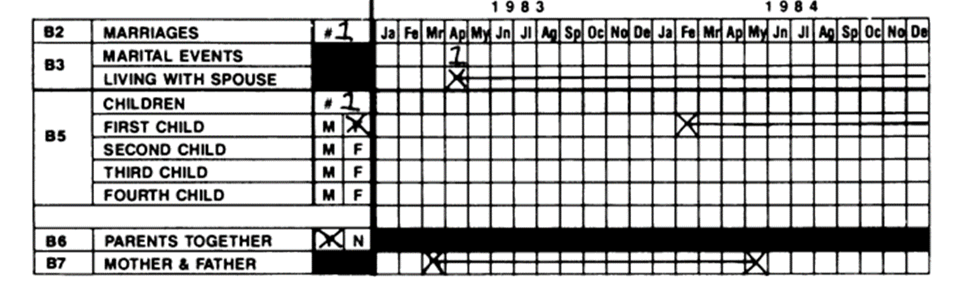
Fig. 1. A visualization of an LHC framework (Freedman, et al. 47).
The difference between the LitHC and the original LHC is that the former tracks literacy activity over time—in this case, Jane’s journals—and most LHCs are filled out by the interviewer alone. Jane and I both filled out the LitHC to ensure she was an active participant in the study. Pictured in Figure 2, my LitHC, like the LHC, utilizes similar time cues denoting the month and year when Jane wrote in “my” journal. Our domain cues focused on the emotion and/or motivation that accompanied each entry to gauge what prompted Jane to write. I developed the domain cues in black ink prior to the interviews based on my initial reading of Jane’s writing (see Figure 2). Jane added domain cues in green ink during our interview as she read the journals in the moment. When we began analysis of an entry, I explained why I coded an entry a particular way, we examined the codes together, and then Jane offered her own thoughts, adding to the calendar as we spoke and refining my assessment of her literacy history. The value of this approach is that we had multiple starting places for conversation, and while my own analysis might have informed Jane’s, I trusted her to tell me if my codes were inaccurate or if she saw codes I did not (the latter happened quite often).3
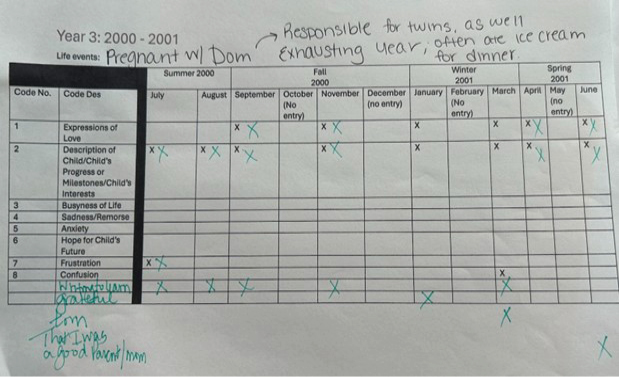
Fig. 2. The LitHC coding schema for 2000-2001.
My role as daughter-researcher inevitably impacted the data collected from the interviews. As Yvonne Lee notes in her own literacy history study conducted with family members, if “a researcher outside of the family conduct[ed] this research, it is highly likely that different memories would have come to the fore” and “alternate remembrances would have manifested” (130). From this perspective, the relationship I have with Jane is not necessarily a disservice to my research. On the contrary, I argue that our relationship strengthened this study as we reciprocally worked alongside one another. As Jane noted in our third interview, it was useful to have me as her interviewer because I was able to “provide context” and fill in the blanks of her memory. Occasionally, as we examined her writing, Jane could sense there was a problem she was responding to, although she could not remember what upset her because “it was a blip in time and didn’t define my whole life.” For example, as Jane and I read an entry from 2008, she noticed her writing sounded anxious, although she wasn’t sure what she was anxious about. I told her my memory of 2008 was limited; regardless, I knew I was in fourth grade and had recently begun attending learning support classes at a learning center after
struggling with school for several years. Almost instantly, Jane saw the journal entry differently. She remembered feeling like she was failing me during this year. She worried the reason I needed further support was because she did not do enough to prepare me for school. To confirm her suspicion, she pulled out the “catch all” journal, and, when she flipped to the pages marked “2008,” this same fear appeared prominently. As she read both journals, she nodded to herself and said journaling helped her “rationalize and process” what felt like a big turning point in my life and her life as a mother. Had I been unfamiliar with this history, this “blip” might have gone unremarked upon during the interview.
Despite our familiarity with each other, Jane often saw codes that I did not. As her daughter, I primarily read Jane’s journal as an act of love, a space to document her children growing up. And so, as Figure 2 shows, many of my codes are marked as “Expressions of Love,” and not much else. I did not initially set out to conduct this study with a focus on WTL because I did not see evidence of it in Jane’s journals during my initial read-through. While it seems naive to say so now, I did not know she had to learn to be a mother. Further, I had a pre-existing idea of what WTL looked like (e.g., a school-based reflective response paper or learning log), and these journals did not fit that idea. The journals never registered to me as a learning tool until Jane coded her entries on the LitHC and pointed out her learning pathways. While Jane agreed her writing was an act of love, she also wrote for other reasons, which she showed me as we coded (see Figure 2). Such a moment underscores the value of the researcher de-centering their perspectives (no matter the researcher’s proximity to the participant) and instead choosing to center and listen to the participant’s perspectives.
Listening to Jane’s perspective can be seen in Figure 2. Figure 2 highlights when WTL was first coded. An entry from July 2000 was assigned “Writing to Learn,” “Frustration,” and “Description of Child.” Jane added the domain cue “Writing to Learn” in green ink and, because she agreed with the other two codes that I had in black ink, she placed a green “X” alongside my black “X.” The entry from July 2000 describes a moment when I, at two years old, somehow opened the refrigerator, retrieved an egg, and cracked the egg on a window sill, which later resulted in a childproof lock on the refrigerator. This was the first “Writing to Learn” domain cue observed in the journals. I offered the language “Writing to Learn” after Jane explained that she journaled this moment to chronicle a humorous event, although she was equally trying to understand how I obtained an egg and how to avoid a repeat in the future. As seen in Figure 2, Jane observed four additional WTL codes in the 2000–2001 calendar year that I did not see in my reading. While Jane and I did not necessarily disagree on many codes, she often saw details that I did not—could not—see without her input. These moments underscore the value of encouraging participants to interpret and interrogate their literate lives alongside the researcher.
Ultimately, the calendar became a key element in understanding the themes across Jane’s literacy history. In what follows, I trace three instances of WTL in “my” parenting journal. While I am the subject of the entries I share, following other lifespan writing research methods that honor participants’ life perspectives and viewpoints (see Dippre and Phillips), I often defer to Jane’s perspective of her journals to build my analysis, especially because I did not initially see evidence of WTL in the entries I share.
Findings: Tracing Three Instances of WTL
While many codes appeared in the LitHC, including but not limited to “Expressions of Love,” “Description of Family/Personal Medical History” and “Children’s Developmental Milestones,” a “Writing to Learn” code appeared in 53% of the entries that Jane and I coded, making it one of her leading motivations for writing. Jane first began writing about her new role as a parent in late 1997/early 1998 following the birth of me and my twin sister. At the outset of her writing journey, Jane’s entries are largely focused on her children’s developmental milestones: when we said our first words, began to walk, or learned letters and numbers. Over time, as her children grew into unique and complex individuals, Jane used her journals to gain new knowledge, often using writing as a learning tool to think through what felt like “big moments” in her life as a parent. Another compelling finding from the LitHC were two codes Jane created and often placed adjacent to WTL: “future parent advice” and “hopes for my children to reflect.” Imagining her children might one day need learning support and guidance as parent novices, Jane hoped her children would read her WTL entries to reflect, perhaps even taking up their own journaling practice, and grapple with their own parent identities. Jane explains further:
I always intended to give the journals to you guys [my siblings and me]. Now, I didn’t initially intend to give them to you until you were parents yourselves . . . I wanted you to have it as a way to go “Oh. Being a parent isn’t easy. My mom struggled with some of these things, too.” There’s nothing easy about being a parent. Kids don’t come with instruction manuals. You have a baby [at the hospital] and they say “Alright, go home. Figure it out.” And you do, but you make lots of mistakes . . . I hoped [the journals] would help you as a mother yourself if you read it someday.
Jane’s rationale underscores that self-sponsored WTL is a mechanism to develop her personal identity while simultaneously developing a space for community meaning making. What strikes me the most about Jane’s above response is her comment that “kids don’t come with instruction manuals,” a sentiment she states three other times in our interviews. While I do not intend to suggest Jane’s journals are a step-by-step instructional guide for parenting, I emphasize this moment because it captures a social function of WTL and its multidirectional nature in our family system. Different from writing to inform or communicate (Britton, Burgess, Martin, McLeod, and Rosen), Jane’s journals are a learning pathway for both her and her readers to make sense of new terrain across time.
Finding #1: WTL is Used for Self-exploration and Identity Development
Jane pinpointed several entries that were WTL-driven and multidirectional in purpose. One of the earliest entries was written in 2002 when I, at four years old, accidentally pushed our TV off the entertainment stand in an attempt to “stand on it”:
All I could think was you could have severely injured yourself or you could have crushed your brother if he’d been lying in front of the TV where he sits 98% of the time. Thank God he was sitting on the couch at the time. Once I realized you were all OK, I started screaming. You ended up sitting in your room for an hour by yourself until I could calm down. I don’t think I’ve ever been that angry with you. But you’re 4 and have no sense of great danger. Once I picked up the TV & you saw that it worked, you said, “See Mommy, it’s OK. I didn’t break it.” Never seeing the bigger picture of what could have happened. Despite all the aggravation I wouldn’t trade you for all the TVs . . . I just have to figure out how to show you there are consequences for your actions and that just because it doesn’t seem to be broken at the time doesn’t mean that harm hasn’t been done.
On one hand, Jane explained that she used her journal to work through this moment because she felt guilty about screaming and about sending me to my room without first explaining the danger of the situation. “What is the right way to discipline your child,” Jane questioned as she explained her motivation for writing that day. “I didn’t like the way I punished you. I was still learning how to be a parent.” Jane uses journaling to consider how she might change her approach in the future. Pointing out that she ends this passage on a forward-looking note about what she can take away from this situation, Jane viewed writing as a way for her to process and learn something essential about her parenting values. Screaming, she contends, does not necessarily help your child learn right from wrong, as evidenced by four-year-old me telling Jane that everything was “OK” because, after all, the TV did not break. What is the right way is something Jane ultimately determines off the page. On the page, the primary learning moment for Jane is recognizing that her gut reaction to scream was not one she wanted to repeat. Writing is a tool for Jane to process her internalized feelings and develop new knowledge about how she wants to proceed in her life as a parent; for Jane, writing is used to discover her personal values and future social action.
On the other hand, as Jane elaborated during the interview, she hoped showcasing her learning process in this entry might help her future readers: “I hoped my vulnerability on the page, on some level, might help you as a parent one day. You could read what I did and decide for yourself what you would do differently or similarly.” Of course, very few parents are prepared for when their child attempts to stand on a TV. Here, as Jane develops knowledge about her personal values as a mother, as well as potentially developing a set of values other parents might adopt, or even change, as they learn from her experience and apply it to their own lives, WTL “functions as a mechanism for learning, self-exploration, and identity development” (Reid, Pavesich, Efthymiou, Lindenman, and Driscoll 42). None of Jane’s children are parents yet, so we cannot know how they might read and interpret this passage, although Jane’s two-tier motivation for writing is striking because it emphasizes the circulation and potential modification of literacy within family dynamics, encouraging us to see how “relationships foster literacy development” and learning (Lee 129).
Finding #2: WTL Develops over Time
While some of Jane’s WTL entries seem to have a clear resolution at the end, like the one above, several passages reflect on a recurring problem over time; in other words, Jane’s learning is not instantaneous and sometimes takes years to develop. One of these recurring problems occurred between 2003–2008 as my sister and I navigated elementary school. When she enrolled us in kindergarten, Jane received pushback from the school about our readiness, claiming we did not possess the skills needed for kindergarten, likely because we had not been enrolled in preschool. Jane’s decision to not enroll us in preschool was justified in a 2002 entry: “People keep saying you need to go to preschool—I think you’ll be in school all day soon enough and I want to enjoy you for as long as I can . . . Soon you’ll go to kindergarten and that is soon enough by my thinking for you to go to school.” One year later, Jane writes the following:
Recently we’ve been debating if you’re ready for kindergarten. The school is not so sure, they feel as though we just haven’t exposed you to things you need to know so we are actively working on those things now. You can spell your first & last name, know your address and phone number, can write your first name, know your birthday, shapes & colors. Can count to at least 12. Know the letters A, B, C, I, O, P, Q, X, N.
The next year of entries are like the above as Jane tracks her twins’ learning progress. As Jane read these entries and coded them on the LitHC, she explained her writing was shaped by the guilt she felt: “Kindergarten was a rough year. There were times I felt guilty because I felt I did the wrong thing . . . This was the first time you were in formal school and people kept telling me I did the wrong thing. I had a hard time with that.” Jane’s guilt about being a “bad” mother is one that permeates the following entries, which highlight how Jane uses WTL to learn a core principle of her parenting philosophy: to accept that she cannot change the past. In this series of WTL passages, writing serves as the first step in learning that, even if she feels she made a mistake, by harboring guilt, she stays rooted in the past and loses “the joy” that surrounds her in the present. In her WTL trajectory, Jane learns over time to forgive herself.
We see Jane beginning to write her way into this learning, although she continues to feel she “did the wrong thing” throughout our time in kindergarten. At the end of kindergarten, Jane comments in my sister’s journal that, despite our learning, she is “afraid the school will think that it [our progress] is not enough.” One year later, as Jane suspected, she was told her daughters were not on track with their peers. She writes in my journal: “Well, I’m not sure how 1st grade is going. You seem frustrated and tired . . . You go to math and reading support, which is good since it gives you some extra help. I regret not sending you to preschool. But I can’t change the past.” My sister’s journal begins similarly: “Well, 1st grade is going OK, I guess . . . school is so different from when I was in school. You’re doing things that I didn’t do till 2nd or 3rd grade. I regret now not sending you to preschool, but I can’t change the past, so we can only push forward and do the best we can.” While Jane observes the need to “push forward,” three years later in her catch-all journal, she continues to reflect upon my sister’s and my academic progress as we navigate fourth grade, writing “I want to let go of the overwhelming burden/fear of my children’s education/well-being. [I want] to really believe that they can learn and that they will be OK in life. [I want] to accept what I can’t change.” When she writes, “I want to accept what I can’t change,” she is referring to that first decision she made in 2002, emphasizing that learning does not occur overnight.
In our interview, Jane acknowledged that maybe (although we can never know for sure) things would have turned out differently had we gone to preschool. Ultimately, journaling about this situation is why, as my brother’s parenting journal details, she enrolls my brother into preschool when he is of age. Jane stated that writing about our progress in school cemented that she “didn’t want to put him through” what my sister and I were experiencing, and so she changed her approach for the future. More important, the above passages continuously cite Jane’s desire “to let go” of the burden she feels and to “accept what she can’t change.” Like the TV entry, writing serves as the first step in the learning process and is the catalyst for determining what to do off the page. Stuck at step one, though, Jane seems to not know how to achieve acceptance. While reflecting on the past can be helpful for learning and improving one’s future, there is a difference between reflecting/learning to move forward from a decision and ruminating/staying stuck in a past decision. To reach acceptance, Jane told me, she needed to change her writing practices to follow these steps (which she still does today): “write it, deal with it, and move on,” a phrase she uses to refer to engaging with WTL without the rumination. To “move on,” for Jane, means to take a more “joyful outlook” in her mindset and future composing after writing about something that needs to be dealt with. Lingering over a choice and feeling guilty, she realized, will do very little to change her past, present, or future. Seeing the joy, such as her twins improving in school, albeit slower than the school’s standards, is what ultimately will help her move forward.
We observe Jane seeing the joy by the end of 2008 in her next entry, suggesting she is moving forward. No longer ruminating, Jane reflects on the end of the 2008 school year in her pregnancy journal:
As I reflect over the past year, I am so proud of you all! You each have had some trial to overcome this year, and you have done it without fear and have been graceful throughout it all . . . Don’t ever give up. Remember after the fear of something new disappears, remember how much fun it will be . . . Learn not to sweat the small stuff.
Our academic progress did not change overnight. Jane’s choice to see the joy also did not happen overnight although, following this entry, her writing notably shifts as she no longer comments on the guilt she feels about a choice she made several years earlier. Instead, she remarks upon her children’s improvement and her happiness for them. Hence, Jane’s reminder that there is “fun” on the other side of “fear,” which she elaborated upon in our interview: “Tomorrow is a new day. Whatever [you] think is going to wreck you probably won’t . . . You’ll hear me say that a lot now, but it wasn’t something I said a lot then.” Writing helped Jane make a notable transition in her mindset and helped her build her parental worldview, and as I discuss in the next series of WTL passages, this worldview is also something she wishes to pass along to her children as they navigate life as parents or as people, generally.
Finding #3: WTL Helps Jane Move Forward
The final sequence of WTL passages follow Jane’s writing from 2012–2013 during another unexpected and strenuous moment in our family history. In 2012, when I was fourteen years old, I had to take a leave of absence from school to receive full-time treatment for an eating disorder. Like the 2003–2008 passages, Jane’s writing during this period is first motivated by feelings of guilt and failure, and eventually, by resolve. In our interview, Jane explained that most of her guilt stemmed from her experiences in nursing school. Taught that eating disorders were the mother’s fault, she felt she did something wrong. I want to be clear, however: she did nothing wrong. To be sure, these mother-shaming assumptions are outdated, and as Jane explained, research on eating disorders has changed and schools likely no longer teach this anymore. While Jane first feels immense guilt, throughout our coding, we saw her learning to resist the mother-shaming discourses she was taught to buy into.
Jane’s first entry for 2012 details this shift in our lives: “Anna has anorexia, it kills a part of me every time I think it, write it, say it, or look at her . . . I don’t understand how to help her . . . I’m certain that to some degree this is my fault. I’m not always the best parent, I have so many faults & insecurities of my own . . . Somewhere along the line, I messed up.” Here, Jane echoes what she was taught in nursing school. Assuming she must have passed on “her faults and insecurities,” Jane ruminates on the maternal politics of blame. In my parenting journal, Jane continues to think about what other potential mistakes she may have made: “I now wonder if the words that I used to describe you as a child, if you misinterpreted them. I’ve always thought of you as unique, that you heard & saw things others didn’t, that you lived in your own world–but all as good things . . . I admit at the moment that I have times now that I feel I have failed you.” Jane’s next entry in her catch-all journal is written three days later, with a direct prayer to God, that continues to place blame on herself: “I have to believe that you will take care of [Anna] through this challenging time of her life . . . Help me to have open eyes, an open heart & mind to this challenge so that I come out on the other side a more caring, loving, & empathetic parent.”
I have little memory of the version of me Jane writes of across the entries shared thus far. It is difficult to describe what it is like to read about yourself making choices you would not make now. It is perhaps even more difficult to read about how your choices have haunted someone else. As Jane and I read and coded these journal entries, we traced her feelings of “inadequacy” as an initial recurring motivation to write, not just here, but in the aforementioned passages as well. In the TV entry, she first wrote out of guilt for screaming—would a “good” mother do that? For the school-
based entries, she wrote out of guilt for not preparing her daughters for school—would a “good” mother do that? Here, she is now writing because her daughter has just been diagnosed with an eating disorder—she must not be a good mother. Jane is a good mother. Jane is “caring, loving & empathetic,” despite her prayer suggesting she’s not.
I felt sick tracing these observations with Jane. I felt guilty for making her feel this way. When I told Jane this, she told me that, while this past version of Jane felt immense guilt, the present version of Jane now sees a considerable learning curve. She elaborated that in moments of difficulty and hardship, it can be so hard to remember the “joy” and the “good times” of your life as a parent and much easier to ruminate on the potential mistakes made. It is why, she surmises, we saw her ruminating so frequently throughout the journal. Around 2012, however, Jane observed that her writing practices began to shift as she chooses to “deal with it and move on” by focusing on the positive, as seen in Figure 3.
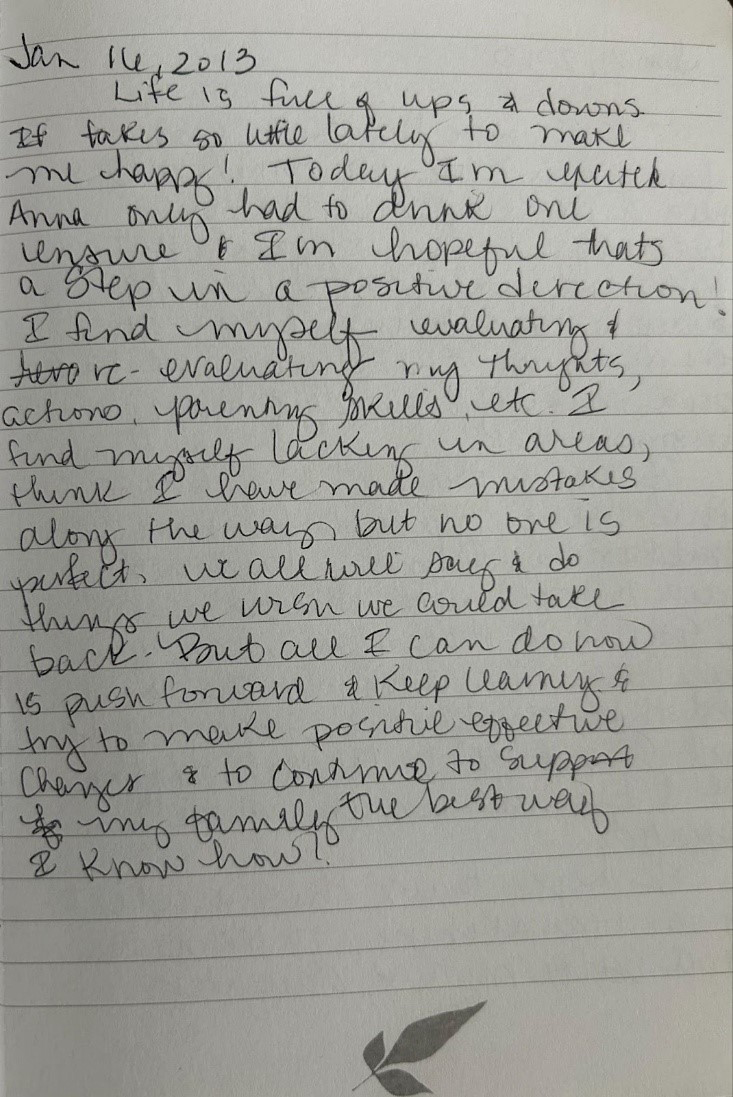
Fig. 3. Jane’s penultimate entry in her catch-all journal
Jane explains her writing: “Here, I’m detailing that I need to take accountability—sometimes I lose hope. But if you step back, you realize that you’re focusing on things that just don’t matter. From here on, I realized I needed to take a more thankful attitude.” When Jane says she realized she was “focusing on things that just don’t matter,” she is referring to her ruminating feelings of digging through the past to pinpoint where she went wrong—an answer, we agreed, she would never find. When she says she needs to adopt a “more thankful attitude,” she is referring to seeing the glimpses of joy, no matter how small, in my recovery. In Figure 3, as in the journal passages written four years earlier, Jane chooses to reflect on what is going well by observing that I am improving in my recovery by only needing to drink one Ensure, a nutritional drink, during treatment that day. While she writes this may be a strange thing to feel happy about, it means that I am moving one step closer towards a full recovery. Rather than casting blame on herself throughout her journals, as she did at the start of my treatment, Jane uses journaling to help her re-position her thinking in seeing the joy, which she acknowledges in her writing in Figure 3: “I find myself lacking in areas, think[ing] I have made mistakes along the way, but no one is perfect . . . All I can do now is push forward.” A few days later, she returns to her journal, continuing to process her internalized feelings:
As I have found so many times in life, we sometimes need a wakeup call, that our lives have become stagnant, not what God intends to find for us. A sudden need to look closer at the decisions and choices we have been making on a day-to-day basis . . . I hope to use this incident as a reawakening . . . I refuse to let this defeat me & to curl up in a ball defeated. I need to focus less on the mistakes I’ve made & move forward.
Jane’s re-evaluation is focused on her day-to-day mindset. Knowing she has spent months ruminating on what she might have done differently to prevent my eating disorder, and in recognizing this is not going to change what has happened, she uses writing to decipher how to navigate this moment in her life. While in this entry, as well as today, Jane still thinks she could have done something differently to stop my eating disorder from happening—feelings that will never go away— I see Jane continuing to learn here that important lesson about focusing on the present as opposed to ruminating on the past. In her final entry in 2013, Jane returns to her journal: “I know this is all out of my hands. All I can do is to continue to love & support Anna the best way that I know.” Over time, writing helps Jane to really learn that sentiment, demonstrating her self-sponsored writing helps her learn a significant lesson about parenting.
Ultimately, Jane stopped writing in 2013 and did not return to any of her journals for seven years, with her final entry appearing in the parenting journals in 2020. Perhaps, we both discussed, she might have learned to truly “move forward,” so much so that she no longer felt the need to write about the unexpected because she already knew what to do off the page. Jane is not sure why she returned to her parenting journals in 2020. Sick with COVID at the time, she remembers sitting in her bedroom and seeing her parenting journals on the nightstand beside her. She picked up all three and wrote a similar entry with the same concluding lines in each of them. The entry from my journal is pictured in Figure 4.
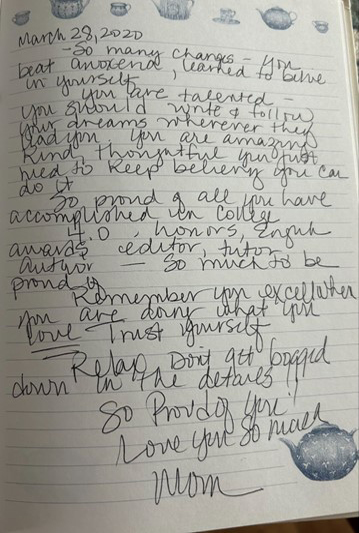
Fig. 4. Jane’s final entry in my parenting journal in 2020.
When I read Jane’s parenting journals now, I see the sentiment “Relax. Don’t get bogged down in the details!!” everywhere. I see this as I re-read the entry about that TV getting pushed down and Jane’s feelings of guilt that her reaction was the wrong one. At the end of the day, we can only learn from our past decisions, recognize we can do something different in the future, and move on. I also see this as I read about Jane’s fear for my academic progress. Alongside her 2020 entry, I remember there is joy on the other side of fear when I read about how I went to college and did well. Ultimately, those struggles were only a “blip” in time. I remember to not get bogged down in what can be done to change the past as I read the entries about my eating disorder because, eventually, I “beat” it and made a full recovery. While these and other challenges may be hard to ignore in the life of a parent, Jane’s writing is an ode to looking forward, to intentionally focusing on the present, and to be forgiving to oneself when the unexpected occurs. While I am not yet a parent, I know I will be taking this message with me when I enter that part of my life.
DISCUSSION & IMPLICATIONS OF FINDINGS
Following the above findings, my study highlights three implications for future research to consider: WTL is a social, identity-bolstering practice; WTL evidence is diverse; WTL data collection can benefit from longitudinal, retrospective, and participatory research methods.
Implication #1: WTL is a Social Practice
The sentiment that WTL is a social practice is the heart of this study. As evidenced in the final pages of Jane’s parenting journals, she wrote to learn from daily parenting experiences that “bogged” her down, such as feeling ashamed for yelling when I pushed the TV down or guilt for not enrolling my sister and me into preschool. While Jane later concedes these details were likely trivial in the larger picture of life, she is only able to observe this because of her WTL practice (and with the retrospection of time, which I address below). These findings emphasize that WTL can help document and comes to terms with one’s identity. WTL helps Jane learn to “see the joy” and to re-think how to approach difficult parenting situations. WTL helps Jane learn to not feel “bogged down” by her mistakes, shaping her social practices as a mother and building her personal identity. In short, examining WTL as a social practice can help us better understand how “writing [is] operationalized for life” and why writing might be used during everyday life (Reid, Pavesich, Efthymiou, Lindenman, and Driscoll 48).
As Jane explained to me throughout our interviews, a parent is rarely born knowing how “to be” a parent. While this study focuses only on Jane, future research can further consider how numerous writers, such as mother-writers, utilize everyday genres, like journals, to engage in personal learning processes outside of formal institutions. Further, Jane intends to pass her journals on to her children when they become parents. While this study could not examine how her children use her journals, Jane’s motivations widen and open possibilities for exploring how literacy moves through self-sponsored contexts and genres. That is, seeing WTL as a “social practice, involving the roles people take, the networks they are part of, and the values and attitudes they hold” can continue to broaden our understanding of why people write to learn (Barton 1, emphasis original). WTL in a parenting journal is simply one avenue self-sponsored WTL can take; there are likely other avenues that we have yet to acknowledge as a field. This study highlights the need to study writers outside of and beyond formal school contexts to better understand why everyday learning happens and how it takes shape.
Implication #2: WTL Evidence is Diverse
When we examine WTL practices outside of academic contexts, we must recognize that evidence of WTL will vary. Collecting and analyzing evidence for a WTL lifespan study may take some detective work, as it is unlikely writers will announce their intentions to learn through writing. As indicated in the methods, I did not initially see WTL evidence in Jane’s journals. My assumptions of WTL evidence were based upon classroom contexts where learning must be made explicit for the purposes of a grade. Because Jane did not write in her journals for the purpose of a grade, nor did she write with the expectation that an evaluator would read her work or that I, for instance, would one day conduct a study about her WTL practices, she was not explicit about her learning process in the journals. Thus, researchers would do well to remember that evidence of WTL in everyday life will not look the same as the “writing to show learning” pedagogies often found in classrooms (Gere 1).
Further, as Jane mentions in the interview, she wanted her journals to be left open for interpretation when her children eventually read them as parents; she wanted her children to decide if they would do something “differently or similarly.” Therefore, as in the TV example, Jane does not disclose to her readers how writing has helped her learn. She does not tell us what she decides to do in the future when she inevitably needs to teach her children right from wrong. In the entries from 2003–2008, Jane does not reveal exactly when writing helped her start “seeing the joy” around her. In the entries about my eating disorder, Jane does not disclose how writing helped her through this difficult period of our family’s life. In many of Jane’s entries, we see her move from one problem to the next, and while it is not directly stated, she has changed as a mother over time through the act of writing. This is how most people write and learn in their day-to-day lives; learning is rarely directly stated for an outsider to assess. This study highlights that lifespan researchers must recognize that self-sponsored everyday WTL will vary from classroom contexts, and as a result, may not even appear to be WTL from a researcher perspective.
Implication #3: WTL Data Can Be Collected Using Longitudinal, Retrospective, and Participatory Methods
Finally, this study’s findings highlight the value of using longitudinal, retrospective, and participatory research methods to collect WTL data. Examining WTL with a longitudinal approach is beneficial because it emphasizes that “[t]ime plays an often invisible but highly influential role” in writing and learning development (Yancey, Robertson, and Taczak 28). Jane needed much longer than a semester to authentically engage in a WTL process; in two of the three cases presented in this article, she requires several months or years of WTL entries to learn from a parenting situation. Just because she wrote about her guilt about my eating disorder or not enrolling me into preschool does not necessarily mean her guilt instantly vanishes. Jane’s experience tells us that WTL takes time.
The value in retrospective data is that it “offer[s] invaluable insights into the processes of people making sense of their literate lives, and of the meaning they attribute to literacy as they tell and interpret their lives” during interviews (Knappick 67, emphasis original). To be sure, Jane’s and my discussion would have taken a different route had I spoken to her about her parenting journals ten or fifteen years earlier because she has changed over time. For example, Jane reiterated multiple times in our interviews that she felt her journals focused on details that “just didn’t matter,” such as my difficulty with kindergarten. She often shook her head at her previous self, as if to say why does this matter? The kids turned out alright in the end. Of course, when she was writing these entries, her feelings were quite different. She had no idea what the future held for me or my sister in 2003. Jane’s retrospective reflection demonstrates how WTL begins, ebbs, and flows. If I had asked Jane in 2003 about these entries, she likely would not have been able to share how writing helped her “move on” from this problem (or others like it), especially because we do not see Jane truly “move on” from this problem until 2008. The passage of time allows Jane to assess her literacy history and explain how WTL is a recursive process that develops over time.
Combining participatory methods with retrospective and longitudinal approaches may also better our understanding of WTL. I would not have discovered Jane’s WTL had I read her journals or coded her entries alone. Using methods that encourage participants to be active in the analysis and coding of their literacy history can help researchers see evidence of literacy in places where we might not have expected to see it, telling us more about the vast reasons why people write across their life. Further, Jane might not have disclosed her WTL pathways had she spoken to a researcher outside of our family system. As discussed in the methods, Jane and I worked alongside each other to produce this study, which involved us filling in the gaps of one another’s memories as we examined each journal entry. While I make no claims that everyone should conduct a study with their parent, this study speaks to how proximity between the researcher and the participant, whether through participatory methods or through a close participant-researcher relationship, can act as a powerful tool in helping us collect and see evidence of literacy in new ways.
As I close this article, I think of a phrase I once read, from where I am no longer sure. This phrase has stuck with me through every stage of this study: it is your parents’ first time living, too. I think of Jane using her journals to navigate her first time living as a parent. I think of who else might be doing the same. I think of Jane’s concluding remark in our interview that “Who I was at 28 is not who I am at 54” and the lifelong road of learning that lies ahead of us after school.
ACKNOWLEDGMENTS
I am grateful for the many people who have helped me revise this article and have encouraged me to share it. First, I would like to thank the editors and reviewers, whose constructive and detailed feedback helped me revise and refine this work. I am also grateful for Laura R. Micciche and Christopher Carter, who both read (and re-read) multiple drafts of this article, and in whose classrooms the idea for this article was born. I could not ask for more encouraging and caring mentors. To Nicholas Muranaka, Joseph Ozias, Katie Monthie, Bethany Hellwig, and Christine Ochs-Naderer, thank you for supporting me in this endeavor and providing your insights from rough draft to finished product. And finally, to my mother, Jane D’Orazio—without her, this article would not exist. I am grateful for her sharing her time, her journals, and her ideas, all of which helped develop this study to what it is. I will always fondly look back on the time we spent together on this project. I am lucky to have her as a mother. She is the best person I know.
NOTES
EDITORIAL NOTES
iLiCs’ editorial policy is to name all authors of a text in the case “et al.” is used. Because many authors contributed to this text, we list them all here: Charles Bazerman, Arthur N. Applebee, Virginia W. Berninger, Deborah Brandt, Steve Graham, Jill V. Jeffery, Paul Kei Matsuda, Sandra Murphy, Deborah Wells Rowe, Mary Schleppegrell, and Kristen Campbell Wilcox.
AUTHOR NOTES
1 I developed the LitHC from the Life History Calendar, a tool used in sociological methodologies to collect retrospective life data. The Life History Calendar is a widely recognized tool in other disciplines and is abbreviated to LHC, so I abbreviate my version of the calendar to LitHC to minimize confusion and underscore the differences between these two tools.
2While useful for most Western audiences, the visual design is not inherently useful for all populations. William G. Axinn, Lisa D. Pearce, and Dirgha Ghimire argue that coding and collecting retrospective individual level-event, time-linked data through a calendar system will not always work, for example, for multinational and transnational communities who do not use Western time measures or employ time records. See their work for a list of revisions that may be made to the LHC if working with such communities.).
3I recognize that trust has much to do with our mother-daughter relationship. If I were conducting this study with another participant, I likely would not have taken this approach in the event a participant felt inclined to agree with my perspective simply because of my role as a researcher. Instead, I would have asked the participant to code their entries during the interview, asking questions about their rationale as the codes occurred.
WORKS CITED
Ackerly, Brooke, and Jacqui True. “Reflexivity in Practice: Power and Ethics in Feminist Research on International Relations.” International Studies Review, vol. 10, no. 4, Dec. 2008, pp. 693–707, https://doi.org/10.1111/j.1468-2486.2008.00826.x.
Axinn, William G., Lisa D. Pearce, and Dirgha Ghimire. “Innovations in Life History Calendar Applications.” Social Science Research, vol. 28, no. 3, 1999, pp. 243–64, https://doi.org/10.1006/ssre.1998.0641.
Barton, David. “The Social Nature of Writing.” Writing in the Community, edited by David Barton and Roz Ivanic, Sage Publications, 1991, pp. 1–13.
Barton, David, and Mary Hamilton. Local Literacies: Reading and Writing in One Community. Routledge, 1998.
Bazerman, Charles, Arthur N. Applebee, Virginia W. Berninger, Deborah Brandt, Steve Graham, Jill V. Jeffery, Paul Kei Matsuda, Sandra Murphy, Deborah Wells Rowe, Mary Schleppegrell, and Kristen Campbell Wilcox. “Introduction.” The Lifespan Development of Writing, NCTE/WAC Clearinghouse, 2018, pp. 3–19, https://wac.colostate.edu/books/ncte/lifespan-writing/.
Beaufort, Anne. College Writing and Beyond: A New Framework for University Writing Instruction. UP of Colorado, 2007.
Bowen, Lauren M. “Age Identity and Literacy.” Enculturation: A Journal of Rhetoric, Writing, and Culture, 8 June 2020, https://www.enculturation.net/age_identity_and_literacy.
Brandt, Deborah. Literacy in American Lives. Cambridge UP, 2001.
Britton, James, Tony Burgess, Nancy Martin, Alex McLeod, and Harold Rosen. The Development of Writing Abilities (11–18). Schools Council (Great Britain), Macmillan Education, 1975.
Chaterdon, Kate. “Writing into Awareness: How Metacognitive Awareness Can Be Encouraged Through Contemplative Teaching Practices.” Special Issue: Contemplative Writing Across the Disciplines, edited by Marlowe Miller and Karolyn Kinane, 2019, pp. 50–66, https://doi.org/10.37514/ATD-J.2019.16.1.05.
Dippre, Ryan J., and Talinn Phillips, editors. “Introduction: Generating Murmurations for an Actionable Coherence.” Approaches to Lifespan Writing Research: Generating an Actionable Coherence, UP of Colorado/WAC Clearinghouse, 2021, pp. 3–11, https://doi.org/10.37514/PER-B.2020.1053.
Emig, Janet A. The Composing Process of Twelfth Graders. National Council of Teachers of English (NCTE), 1971.
—- “Writing as a Mode of Learning.” College Composition and Communication, vol. 28, no. 2, 1977, pp. 122–28, https://doi.org/10.2307/356095.
Flower, Linda, and John R. Hayes. “A Cognitive Process Theory of Writing.” College Composition and Communication, vol. 32, no. 4, 1981, pp. 365–87, https://doi.org/10.2307/356600.
Freedman, Deborah, Arland Thornton, Donald Camburn, Duane Alwin, and Linda Young-DeMarco. “The Life History Calendar: A Technique for Collecting Retrospective Data.” Sociological Methodology, vol. 18, 1988, pp. 37–68, https://doi.org/10.2307/271044.
Frye, Joanne S. “Narrating Maternal Subjectivity: Memoirs from Motherhood.” Textual Mothers/Maternal Texts: Motherhood in Contemporary Women’s Literatures, edited by Elizabeth Podnieks and Andrea O’Reilly, Wilfrid Laurier UP, 2010, pp. 187–201, https://doi.org/10.51644/9781554582921-013.
Gere, Anne Ruggles. Roots in the Sawdust: Writing to Learn Across the Disciplines. The WAC Clearinghouse; National Council Teachers of English, 1985, https://eric.ed.gov/?id=ED262419.
Herrington, Anne J. “Writing to Learn: Writing Across the Disciplines.” College English, vol. 43, no. 4, 1981, pp. 379–87, https://doi.org/10.2307/377126.
Kawash, Samira. “New Directions in Motherhood Studies.” Signs: Journal of Women in Culture and Society, vol. 36, no. 4, 2011, pp. 969–1003, https://doi.org/10.1086/658637.
Knappick, Magdalena. “Making Sense of a Person’s Literate Life: Literacy Narratives in a 100-Year-Study on Literacy Development.” Approaches to Lifespan Writing Research: Generating an Actionable Coherence, edited by Ryan J. Dippre and Talinn Phillips, 2021, pp. 67–80, https://doi.org/10.37514/PER-B.2020.1053.2.04.
Lee, Yvonne. “Toward an Understanding of the Multidirectional Nature of Family Literacy Development.” Dippre and Phillips, pp. 127–41.
Melzer, Dan. Assignments Across the Curriculum: A National Study of College Writing. Utah State UP, 2014.
Naftzinger, Jeff. “A Definition of Everyday Writing: Methods for a Writer-Informed Approach to Lifespan Writing.” Dippre and Phillips, pp. 81–95.
Nowacek, Rebecca S., Rebecca Lorimer Leonard, and Angela Rounsaville. “Writing across Contexts: From School to Work and Beyond.” Writing Knowledge Transfer: Theory, Research, Pedagogy, Parlor P/WAC Clearinghouse, 2024, pp. 272–314, https://wac.colostate.edu/books/referenceguides/transfer/.
Osorio, Ruth. “Constellating with our Foremothers: Stories of Mothers Making Space in Rhetoric and Composition.” Constellations, 18 Aug. 2021, no. 4, https://constell8cr.com/articles/mothers-making-space-rhet-comp/.
Powell, Katrina M., and Pamela Takayoshi. “Accepting Roles Created for Us: The Ethics of Reciprocity.” College Composition and Communication, vol. 54, no. 3, 2003, pp. 394–422, https://doi.org/10.2307/3594171.
Reid, Jennifer, Matthew Pavesich, Andrea Efthymiou, Heather Lindenman, and Dana Lynn Driscoll. “Writing to Learn Beyond the University: Preparing Lifelong Writers for Lifewide Writing.” Writing Beyond the University: Preparing Lifelong Learners for Lifewide Writing, edited by Julia Bleakney, Jessie L. Moore, and Paula Rosinski, Elon U Center for Engaged Learning, 2022, pp. 38–50, https://www.centerforengagedlearning.org/wp-content/uploads/2022/08/writing-beyond-the-university-2022-10-04-revised.pdf.
Rosenberg, Lauren. “‘Still Learning’: One Couple’s Literacy Development in Older Adulthood.” Literacy in Composition Studies, vol. 6, no. 2, Nov. 2018, pp. 18–35, https://doi.org/10.21623/1.6.2.3.
Rosinski, Paula. “Students’ Perceptions of the Transfer of Rhetorical Knowledge Between Digital Self-Sponsored Writing and Academic Writing: The Importance of Authentic Contexts and Reflection.” Critical Transitions: Writing and the Question of Transfer, edited by Chris M. Anson and Jessie L. Moore, UP of Colorado/WAC Clearinghouse, 2016, pp. 247–71, https://doi.org/10.37514/PER-B.2016.0797.
Stone, Jayne. “Putting It All on the Table: Making Visible the Material Realities of Single-Mother Graduate Student Writers.” Writers: Craft & Context, vol. 4, no. 1, 2023, pp. 4–14, https://doi.org/10.15763/issn.2688-9595.2023.4.1.4-14.
Taczak, Kara, and Liane Robertson. “Metacognition and the Reflective Writing Practitioner: An Integrated Knowledge Approach.” Contemporary Perspectives on Cognition and Writing, edited by Patricia Portanova, J. Michael Rifenburg, and Duane Roen, UP of Colorado/WAC Clearinghouse, 2017, pp. 211–29, https://doi.org/10.37514/PER-B.2017.0032.2.11.
“The Writing through the Lifespan Collaboration.” Writing through the Lifespan, 2024, https://www.lifespanwriting.org/, Accessed 18 July 2024.
Vaughn, Lisa M., and Farrah Jacquez. “Participatory Research Methods—Choice Points in the Research Process.” Journal of Participatory Research Methods (JPRM), vol. 1, no. 1, 2020, https://doi.org/10.35844/001c.13244.
Vieira, Kate. Writing for Love and Money: How Migration Drives Literacy Learning in Transnational Families. Oxford UP, 2019.
Wetherbee Phelps, Louise. “Bouncing Back: Resilience and Its Limits in Late-Age Composing.” Literacy in Composition Studies, vol. 10, no. 2, May 2023, pp. 1–37, https://doi.org/10.21623/1.10.2.2.
Whithaus, Carl, Jonathan Alexander, and Karen Lunsford. “When Things Collide: Wayfinding in Professional Writers’ Early Career Development.” Literacy in Composition Studies, vol. 9, no. 1, Jan. 2022, pp. 1–22, https://doi.org/10.21623/1.9.1.2.
Winslow, Dianna, and Phil Shaw. “Teaching Metacognition to Reinforce Agency and Transfer in Course-Linked First Year Courses.” Contemporary Perspectives on Cognition and Writing, edited by Patricia Portanova, J. Michael Rifenburg, and Duane Roen, UP of Colorado/WAC Clearinghouse, 2017, pp. 191–209, https://doi.org/10.37514/PER-B.2017.0032.
Yancey, Kathleen Blake, Joe Cirio, Jeff Naftzinger, and Erin Workman. “Notebooks, Annotations, and Tweets: Defining Everyday Writing through a Common Lens.” South Atlantic Review, vol. 85, no. 2, 2020, pp. 7–34, https://www.jstor.org/stable/27109113.
Yancey, Kathleen Blake, Liane Robertson, and Kara Taczak. Writing Across Contexts: Transfer, Composition, and Sites of Writing. Utah State UP, 2014.
Yoshihama, Mieko, Brenda Gillespie, Amy C. Hammock, Robert F. Belli, and Richard M. Tolman. “Does the Life History Calendar Method Facilitate the Recall of Intimate Partner Violence? Comparison of Two Methods of Data Collection.” Social Work Research, vol. 29, no. 3, 2005, pp. 151–63, https://doi.org/10.1093/swr/29.3.151.