Modernity and the Rhetorics of Reform:
The State Language Debate in Bangladesh (then East Pakistan)
and the Proposal for Shahaj Bangla
Shakil Rabbi—Virginia Tech
KEYWORDS
language ideology; language movement; literacy studies; translingualism
INTRODUCTION
We shall know the truth and the truth will make us free.
––East Bengal Language Committee Report
The social function of literacy is a staple of conversation in writing studies. It includes critical interrogations of the “literacy myth” (Graff) and the “great divide” (Ong) to engage social complexities predicated on contemporary globalization. We recognize that literacy is not neutral and functions—does work—for both individual users and structuring power relations through ideologies or “metadiscursive regimes” (Bauman and Briggs 17). Issues such as mobility, materiality, and networks, which shape how it is experienced and valued across different communities and temporalities have come to be especially highlighted in recent decades (Canagarajah, “Weaving”). This development has been part of our disciplinary commitment to pointing out that literacy and languages are deeply intertwined with wider phenomena; consequently, the social status quo influences whose voices are heard and whose are marginalized in subtle and profound ways.
Examinations of discourses in the state language debate in Bangladesh (then East Pakistan), I believe, offers an informative contribution to this conversation. This seminal event in the subcontinental history took place in Pakistan during its first decade of independence, roughly between 1948 and 1956. At the time Pakistan was made up of two wings: a multiethnic West Pakistan, which is what is now Pakistan, and a Bengali dominant East Pakistan, which is now Bangladesh. On its face, the state language was a political dispute over whether Pakistan would have one state language (Urdu) or two (Urdu and Bangla) and culminated with the recognition of the two state languages in the first Pakistani Constitution in 1956. At its core, however, it was a fight over national identity, political and democratic power, and cultural hegemony. More relevant to the topic of this article, a political and disciplinary deliberation over Bangla language reform took place during the state language debate, wherein different sides proposed distinct initiatives to transform Bangla to suit the needs of Pakistani nationalism and development.
On one side of this debate over language reform were government elites, mostly Urdu speakers who resided in West Pakistan. They proposed that Bangla be written in the same Nastalique script as Urdu (derived from the Perso-Arabic) rather than the traditional Bangla script. Their recommendations for a common script for the two languages came about after government proposals for making Urdu the sole state language of Pakistan faced mass protests and political resistance in the Bengali majority province of East Pakistan. On the other side of the debate were Bengali intellectuals who proposed reforming Bangla into a simplified register called Shahaj Bangla using traditional Bangla script; these intellectuals and their proposal were a part of the wider social and political movement in the province that resisted government plans of making Urdu the only state language (now popularly known as the Language Movement). The rhetorics around Shahaj Bangla, which engaged with both practical and political considerations of linguistic reform, I believe, is illustrative of a dialogism of two dominant modern linguistic ideologies—a Lockean view of language as a system of communication and a Herderian view of language as cultural idealization—that seem contradictory at first glance. It also represents an example of “rhetorical sovereignty” or the right of a community to “decide for themselves the goals, modes, styles, and languages of public discourse” set in a context of multilingualism (Lyons 450).
Consequently, I see an examination of the rhetorics of reform and the discourses of the state language debate in Bangladesh (then East Pakistan) nuancing the critical scholarship spotlighting the foundational role of language in the construction and reproduction of colonial communities and modern hierarchies that structure contemporary societies (Bauman and Briggs; García and Baca). John Trimbur, in his studies on laissez-faire language policy in the early days of the US Republic, showed that the establishment of an American English provided “a purity of origin [narrative of the genius of Anglo-Saxonism and] a uniformity of expression that guarantees its function in binding the nation into a common speech community” (582). Even though the United States Constitution does not include a declaration about language, a default monolingual policy emerged as “one definitive quality of the U.S. postcolony is the shallowness and limits of the process of decolonization” (578). This episteme aligned neatly with the project of US expansion and coloniality “representing American Indian languages as extinct or dying…[and] the inventive hybridity of African American language into a deficient and disabling dialect” (580). This strategy extended as the US grew into a framework for casting non-mainstream populations, minorities, and immigrants as inappropriately literate for democratic membership (Shepley; Wan). An exclusionary function of literacy and views around language continue to be evident in contemporary English-only discourses in the US (Flowers) that seek to reinforce a monolingual norm as a desired marker of modernity and nationalism.
This critical scholarship, though invaluable, does not do justice to the complexity of ideologies around languages and literacies manifested in circumstances of a modernity defined by fundamental transformations and ever-increasing complexity across material, social, and cultural domains (Bauman and Briggs), and the recognition that contact zones sedimented in multiple networks and regimes of power are everywhere. What is needed, it seems to me, is extending our conversation on the relationship among language, identity, and modernity beyond the experiences and policies of Eurocentrism (Sugiharto). We also need to recognize how social categories of difference, such as religion or speech communities, shape literacy and views of language alongside Eurocentric and secular concepts such as race, gender, and class (coded either in terms of region or race) that have provided our primary analytical vocabulary for understanding language (Engelson). This expansion of the conceptual framing also must happen alongside our reframing of the conversations around language ideology and globalism as not overdetermined by colonially constituted interactions and situations, often taking the form of examining negotiations between European languages with cultural capital (e.g., English and French) and others (Mandarin, Arabic, etc.).
Such adjustments align with the exigencies of the global turn in writing studies that asks us to adapt conceptualizations of literacies developed within an US framework to the contemporary transnational context (Hesford; Olson and Reddy). Translingualist scholarship, in the last decade and a half, has been a fitting response in this area, from studying the impacts of multilingual practices (Canagarajah, Translingual Practice), dispositions (Lorimer Leonard), or multimodalities (Gonzales) to researching the myth of monolingualism in Western communities (Matsuda; Kimball). This scholarship has also extended our frames to account for practices and language ideologies situated in the Global South (Engelson; Sultana). It has done this generally with a view of connecting “metadiscursive regimes around language” and literacy to asymmetries of power and foregrounding the fluid nature of linguistic resources within a decolonial agenda “respectful of literacies from elsewhere, while mindful of the dangers of appropriation” (Canagarajah, “Weaving” 23).
This essay examines the proposal for Shahaj (Simple) Bangla in the context of the state language and language reform debates in Bangladesh (then East Pakistan) to build on this global turn and translingualist scholarship specifically. I begin by detailing the historical background and rhetorical context of the debate—particularly how reform proposals concerning script, education, and cultural identity reveal underlying ideological conflicts and “discursive interconnectivities” (Mao 103). I then provide a close reading of the 1950 East Bengal Language Committee (EBLC) report, which rejected the government proposal for reforming Bangla by using a unified script, instead recommending the creation of a register of Bangla that was suited to the needs of development and nationalism. Finally, I discuss how the proposal for Shahaj Bangla exemplifies a collective “rhetorical sovereignty” rooted in scientific modernization and cultural representation, ultimately offering important insights into the dialogism of language ideologies.
A SENSE OF REFORM IN THE CONTEXT OF THE STATE LANGUAGE DEBATE
IN BANGLADESH (THEN EAST PAKISTAN)
The state language debate in Bangladesh (then East Pakistan) is a seminal event in subcontinental history, often understood as seeding Bangladeshi nationalism and prefiguring the Bangladeshi War of Liberation of 1971. On one side of the debate were the ruling elites of Pakistan, most of whom resided in West Pakistan and spoke Urdu. This group—called muhajirs because they had immigrated to Pakistan as a part of the 1947 Partition of British India—championed Urdu as the only language suitable for a state founded on an Islamic identity. On the other side was a group that has now come to be called the Language Movement, made up of Bengali activists, politicians, students, intellectuals, artists, and many others. They proposed two state languages (Urdu and Bangla) for Pakistan and called proposals for Urdu as the sole state language a, in the words of a 1949 newspaper editorial, “conspiracy to destroy Bengali culture” by muhajir ruling class (Al-Helal 216).
Details the history of the Language Movement and the state language debate in Bangladesh overall will not be expounded here—numerous excellent books on the topic exist already.1 Readers interested in the specifics can refer to a concise exposition of the movement in Language Movement in East Bengal by Badruddin Umar. What I will say is that the debate reached a boiling point on February 21, 1952, when government forces attacked a large demonstration in Dhaka, in then-East Pakistan, and killed several protesters. The brutality of this response caused wide-scale outrage, and the Language Movement transformed into a “movement of the broad masses of the people for the overthrow of the existing government” (Umar 223). Demands for Bangla and justice for the “language martyrs” killed by security forces became a mass rallying cry and helped the local parties win a supermajority in the 1954 East Pakistan Provincial Election. The day is now a national holiday in Bangladesh. In 1999, UNESCO, honoring the movement and its sacrifices for their mother language, recognized February 21st as International Mother Language Day.
What is salient to my discussion about the rhetorics of language reform here, however, is that the debate over state language initially took place in the discursive political spaces of policymakers’ proposals and the rhetorics of experts before it transformed into a “mass political movement” after 1952 (Umar 222). The episode I look at here to develop my discussions about language reforms and their rhetorical significances took place during this initial phase and came about in the context of government proposals to write Bangla in Nastaliq, the same script as Urdu. Fazlur Rahman, a prominent member of the muhajir and Pakistan’s Minister of the Interior, argued at the 1949 Educational Conference that a single script for all languages in the nation would align infrastructures of literacy between the two wings. This idea for reforming Bangla in terms of changing its script came about after government proposals in 1948 to make Urdu the sole state language immediately faced widespread political resistance in East Pakistan.
As a part of this proposal, pilot projects were set up, and a committee, called the East Bengal Language Committee (EBLC), was tasked to evaluate the feasibility of writing Bangla in the Nastaliq script. The committee, made up of Bengali linguists and educationists, surveyed local opinions, deliberated with experts in the province, and rejected the idea. Their report—rejecting the government proposal of a unified script—recommended rather that Bangla should be reformed to suit “the country of Islamic ideology and culture” (12). This reformed language, which they called “Shahaj Bangla” (simple Bangla), would be written in the “Bengali script” (11) because it was better suited to the language. The government of Pakistan ignored the report, not making it public until 1958; nonetheless, significant parts of it were published in various newspapers at the time and informed the discourses of the broader state language debate.
For those of us in literacy and writing studies, the discourses of the state language debate in Bangladesh (then East Pakistan) and the rhetorics of reform articulated by the report and its articulations of Shahaj Bangla provide a useful record to examine ideas and ideologies about language and literacy in a non-Western context (Hesford; Sultana). Specifically, we can see from the contours of the debate an interplay between regimes of language and how they are indexed in discourses around language reform set in contexts of nationalism and modernity. A distant reading, with its protocol of translating texts into data, data into visualizations, and visualizations into interpretation, I found, is generative for making “dynamic…patterns obvious” (Mueller 3). It provides a “systematic treatment for surfacing patterns” (167) to guide close readings.
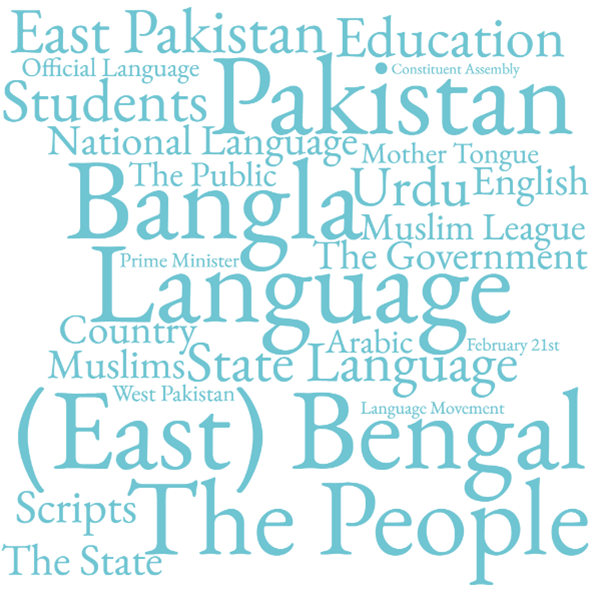
Consequently, I used two types of visualizations to get a sense of the rhetorics of language reform in the context of the discourses of the state language debate. The first is a word cloud of frequent terms (28 terms) in a record of the state language debate2 and frequent terms (28) in the reform corpus.3 These are shown in Figure 1. To generate these word clouds, I compiled a corpus out of the extant records of public texts related to the state language debate from 1946 to 1956 (adding up to 257,001 words). I then created a sub-corpus focused on language reform based only on those records related to writing Bangla in the Nastaliq script and reforming Bangla (adding up to 70,032 words). The frequent words in the reform corpus were distinguished in terms of their keyness, or their statistically significant prominence, using the larger state language debate corpus as the reference corpus (Aull). This procedure brought into focus discursive and semantic patterns that were significant and distinct to the rhetorics around language reform. Put simply, the word clouds illustrated in Figure 1 showed what was representative of the discussions around Bangla language reform.
 |
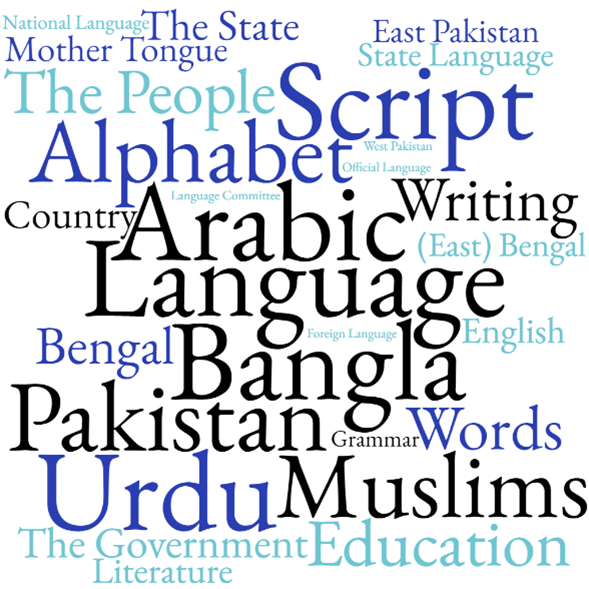 |
Fig. 1. Word clouds of frequent terms in the state language debate. The first image represents the general corpus (n=257,001), and the second represents the reform sub-corpus (n=70, 032). Words in the reform sub-corpus are color-coded for keyness as keywords. (Black for highest significance, Dark Blue for high significance, and Blue for moderate or no significant keyness.
The word cloud on the left in Figure 1 illustrates the discursive and semiotic prominence given to discussions around language and national imagining in the debate in terms of discrete word units, “discursive interconnectivities” in the state language debate (Mao 103). It confirms that rhetorics in the debate aimed to constitute a people (words indexing political actors such as nations, government representatives, communities are prominent) making a demand (words indexing languages’ various forms are also prominent). This word cloud makes clear, as the event is now understood, the debate was as much about creating a people who were making a demand as it was about the demand for state language recognition of Bangla itself (Umar).
The word cloud of the reform sub-corpus, on the right of Figure 1, has many words in common with the word cloud on the left. A comparison between the two, however, makes a nuance between them clear. Some common words have a higher keyness and are more frequent in the reform corpus. The list of most frequent words also includes a set that does not appear as heavily in the general corpus (I included the Language Committee term there even though it is not that frequent because I know it is important and shows up in the text in pronoun form as well as in its proper noun form). These include the following: writing (highest significance), words (high significance), alphabet (high significance), literature (moderate or no significance), grammar (high significance), language committee (moderate or no significance), and foreign language (moderate or no significance).
This list highlights how the discussions around reform were about the modularity and functionality of Bangla. Firstly, it reflects the fact that this conversation was a debate about the government proposal to write Bangla in Nastaliq, illustrated by the high keyness of words such as script and writing in this corpus; Arabic is also a frequent unigram but here it signifies discussions about the Nastaliq script (catachrestically called Arabic since Nastaliq is derived from the Arabic script) script rather than the Arabic language. Secondly, it exhibits a focus on the compositional elements of a language, such as its written form, its alphabet, its grammar, and its words. Thirdly, it shows culture as a significant consideration in discussions about reform, with the frequency of the unigram Literature and Bengal (denoting the region and the cultural space).
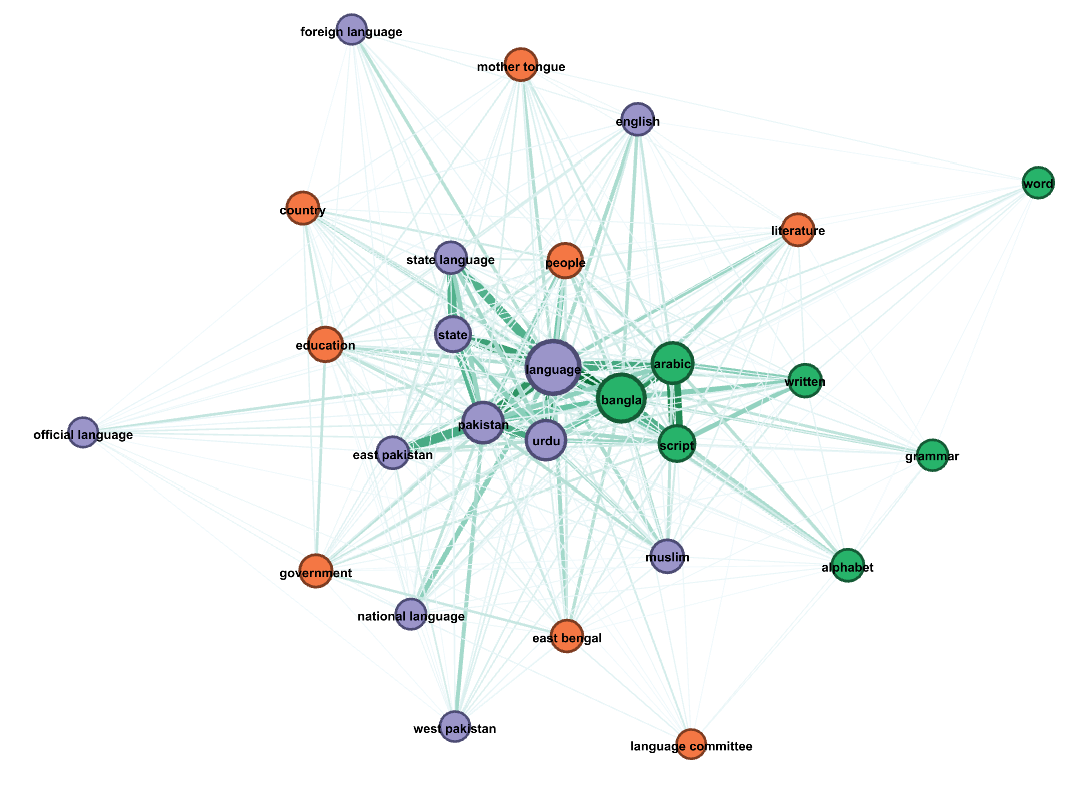
These constituent parts of the rhetorics of reform are also evident in a semantic network shown in Figure 2.4 This is the second form of visualization I use. This graph clusters words in terms of their frequencies overall and how often they co-occur with other frequent terms. Based on this logic the most important and common words are situated and densely packed in the center. They show that the central terms—most frequent overall and closely occurring with other terms—are language, Urdu, Bangla, Pakistan, the state, Arabic, and script. Other terms revolve around them, as satellites around a larger body with a heavier gravitational pull. Put plainly, this semantic network shows that when someone was talking about changing how Bangla was written, they were doing so in the context of discussions about the role of the language in the state, and whether Urdu or Bangla was fit to be the medium of the Pakistani state. Figure 2 thus reiterates the network sense of Figure 1 that discussions of reform structurally echo the overall discourses and framework of the state language debate. The keyness of the two conversations are the same at its core.
|
|
|
This semantic network represents a network of the most frequent terms that co-occur in the reform sub-corpus. The categories are made through a Louvain method of community detection and is laid out using ForceAtlas 2 algorithm in Gephi. |
Figure 2: Semantic network of significant terms.
At the same time, this semantic network shows frequent terms unique to the reform discussions in terms of their own “discursive interconnectivities” (Mao 103). A Louvain method of community detection provides three categorical clusters or topics (Segev), each represented by a color.5 The community on the right end, colored green, represents the discussions talking about the elemental units of language in the reform conversation: alphabet, written form, the words, grammar, as well as scripts, Arabic (which is in this context is mostly about the Nastaliq script), and Bangla. They are seen in relation to discussions around the role of language in the state, colored purple, which are at the center of the network. The green cluster, in other words, foregrounds the semantic units making up the discussion about reforming Bangla in terms of its lexicon, its script, or grammar to suit the needs of Pakistan.
These distant readings of the record evidence that language and the nation-state are deeply intertwined (Trimbur; Brandt). The debates around state language in Pakistan extended beyond the question of Bangla’s utility as an effective medium for state communications. These debates evolved into proposals for reforming fundamental and functional elements of Bangla to suit a modern nation based on Islamic identity and as such is suggestive of the recognition that languages are essentially connected to people and communities. The proposal for Shahaj Bangla put forward in the EBLC report—alongside rejecting the government’s idea of a unified script—is an illustrative example of this social function of language. In the following section, I explore the dialogism of language ideologies underlying the Shahaj Bangla proposal.
MODERNIST IDEOLOGIES AND
THE SHAHAJ BANGLA PROPOSAL:
CLOSE READING “THE REPORT OF THE EAST BENGAL
LANGUAGE COMMITTEE”
Critical research on languages often centers around language ideology, from intersections of language and race (Rosa and Flores) to language and global capitalism (Olson and Reddy) to multilingualism and monolingualism (Lee). These conversations highlight the idea that extant views around literacy and language are constituted in terms reflective of power and the social status quo. Consequently, they call for demystifying our epistemologies for communication as objective representations of reality.
The “Report of the East Bengal Language Committee”6 is substantially reflective of this phenomenon. The document presents the government with an argument for language reform exigent to the “linguistic problems” and “new political and cultural set-up of the country” (“Report” 5). The report’s primary propositions for a reformed language, Shahaj Bangla, is grounded on the rhetorical commonplaces of modern education (what language would be the best medium for it in the province) and practicality (make use of extant resources in Pakistan). It concludes that implementing Shahaj Bangla will “produce directly far-reaching effects on the educational and cultural life of the country, in as much the system of spelling, writing, printing, typing, etc., may affect the educational and cultural life of a country. Yet they will not create any disturbance to the fundamental genius of the language of the soil” (“Report” 12). These reforms would develop the province and promote Islamic nationalism across the two wings.
An ideology of modernity is evidenced in the proposal in two ways. On the one hand, the experts presented the reformed language in terms of its social function. It could be the medium of communication in education and cultural life (Brandt). This is language in the Lockean sense, a code that works through standardization and a “process of decontextualization” (Bauman and Briggs, 65). On the other hand, the experts were also clear that languages were not only for communication. This aspect of their rhetoric subscribed to the Herderian perspective that was foundational for European nationalism, wherein language was “the reservoirs and the means of giving expression to the distinct spirit of a people, the Volkgeist” (192).
The Lockean sense of language is prominent in the emphasis of Shahaj Bangla’s functionality. It would be the medium of literacy, and standardization was key to this. The experts recommended that Shahaj Bangla be based on scientific principles that “would remove the defects of the Bangla tongue” (14). The new form would serve the general population better by simplifying the vocabulary, reducing the number of letters, standardizing spelling based on phonetics, and basing grammar in terms of usage. This is the frame identified in the green sub-network in Figure 2, comprised of terms alphabet, grammar, writing, script, and so on.
For the alphabet, the “Report of the East Bengal Language Committee” recommends reducing the number of vowels and consonants, and simplifying how vowels would be written in their diacritical forms (Bangla vowels often take diacritical forms when combined with consonants). The report says:
Of the present Bengali alphabet only অ, আ, ই, উ, এ, ও (/ɔ/, /ɑ/, /i/, /u/, /e/, /o/) — these six Vowels be retained and others be omitted as superfluous. With these list of six Vowels, another new vowel of the shape like অ্যা [a new letter, /æ /] be added to represent the oblique sound of এ-e as is often found in Bengali words, like ঠাকুর, বাঘ, দাদা, (/ʈʰakuɾ/,/baɡʱ/,/dada/) etc., bringing the list of Vowels up to a maximum limit of seven, as follows: অ, আ, ই, উ, এ, ও; All the 7 (seven) Vowels of ‘Shahaj Bangla’ shall be retain their ‘Kar’ [diacritical] forms with certain modifications as shown below, in order to make them fit in with the modern mechanical devices for writing, printing, typing, etc., and be added to the right side of the Consonants they follow. (9–10)
A scientific rhetoric rationalizes these orthography recommendations: “If Bengali spellings are to represent faithfully the modern Bengali sounds, in other words, if Bengali spellings are to be made quite scientific, they require to be simplified and standardized from a phonetic point of view” (“Report” 99). It also says that “all conjoined letters be disjointed, so that elements may be placed side by side” (100), making writing easier since words would have to be written out in terms of separate letters based on consonants and vowel sounds (as in English), and conjoined letters would no longer be used (reducing the number of letters needed to be learned for literacy).
Regarding the simplification of language, the report emphasizes the “vocabulary of the masses as the first step towards simplification because the masses use simple language with easy vocabulary” (101). (I expand on this sense of simplification as reflecting an Islamic identity in the second half of this section). An important rationale in the Lockean view of language as a medium of communication—though scholars have pointed out the class prejudices of such a principle—is clarity and avoiding “the cheat and abuse of words” (Bauman and Briggs 36). Finally, suggestive of the linguistic expertise of its members, the committee argues for minimum prescriptions over grammar since the “simplification of other spheres . . . is bound to bring about certain simplifications in grammar too.” In a type of qualified descriptivism, the report says, “any attempt at simplification of grammar before the growth and development of the type of language and literature visualized in these pages of our recommendations, will mean putting the cart before the horse” (103).
The report is aware of itself as a political document and a genre, and therefore its presentation of Shahaj Bangla as facilitating communication is central to its rhetoric. Firstly, it argues that Shahaj Bangla is a technological innovation that reduces the number of symbols required for printing from 480 symbols to 65, meaning a “[reduction] of labour and facility and speed in composition [is] expected to be double the present amount” (“Report” 13, [sic]). The new script makes manufacturing Bangla typewriters easier, “on the same level as the English one, nay, even on a higher level from the point of view of the number of keys and easy way of handling them.” The effect of Shahaj Bangla on the infrastructure of literacy makes mass communication and individual literacy more viable.
Secondly, the report emphasizes that Shahaj Bangla will “help the spread of literacy by leaps and bounds among the masses and the non-speakers of the language,” and if implemented “it is legitimately expected that mass-education will increase by employment of the new system” (14). This reasoning recognizes the anxieties of the Pakistani ruling class, who saw Bangla as too complicated to deploy systematically across schools in Pakistan; the report argues that the Shahaj Bangla would be “easier and more scientific than the present form of English [which most of them were literate in and used in their official work].” It appeals to goals of governance since it would promote basic literacy by removing some of “the greatest stumbling blocks or learning, reading, writing, printing, and typing” (“Report” 49).
A Herderian view of language is equally salient to the rhetoric of Shahaj Bangla. As the report frames it, this reformed register would disassociate Bangla from Sanskrit and ground it in the local place and society. The report says that a clear-eyed understanding of Bangla shows that
Bengali is not a direct descendant of Sanskrit. It is the immediate deviation of Prakrit, and as such, it maintains characteristics overwhelmingly Prakrit in nature. In the realm of spelling, a systematized attempt at Sanskritization was made in the 19th century, the result of which has rendered the present spelling almost impossible to be mastered by the people having little education, nay, even by Bengali scholars. (42)
This exposition underscores the need to recognize that Bangla evolved from Prakrit, a language indigenous to the region. The Sanskrit characteristics of formal, written Bangla were imported into it and represented “ideas foreign to Bengali genius” (“Report” 103). Furthermore, grounding the moment of this process of Sanskritization in the 19th century Bengal Renaissance, the report frames this feature as a relatively recent and superficial development in the language. It also associates this aspect of Bangla to colonial rule, implying that Hindu Bengalis codified modern Bangla during the Renaissance in such a way so as to incorporate cultural capital associated with Sanskrit during the period (Pollack).
One aim of Shahaj Bangla thus becomes extricating Bangla from this influence. The report is clear throughout that Bangla lacks systematicity because prescriptive norms (codified during the 19th century) were developed to accommodate Sanskrit words and syntax, distorting the language in everyday usage (for example, Sanskrit nouns and adjectives have distinct gender forms and Bangla does not). Pakistani independence represented an exigence for returning Bangla into its living form as used by the Bengali Muslims of the province “through the incorporation of more Arabic-Persian words. If it could be made a little more Muslim, it could be presented as sufficiently compatible with the Pakistani State (Azam).7The experts explain that the “present literary Bengali [sic] consists mostly of difficult and unintelligible Sanskrit tatsama terms, technical words and phraseology culled from Sanskrit Dictionary and as such does not represent the language of the people” (“Report” 53). This fetishization of Sanskrit had distorted Bangla and made Bangla literacy unsuitable for representing the spirit and culture of East Pakistan. Bangla’s phonetics was jammed into orthographic rules meant for spelling Sanskrit words wherein “only about 30 percent of the words of Tatsama origin are ruling over the spelling of the rest of the words of Tatbhava, indigenous and foreign origin” (“Report” 40). It made grammar of written Bangla incoherent to make it “more Sanskrit in character and form than the language itself” (“Report” 103). This valorization corrupted the living language into a form inaccessible and inappropriate as a medium of expression and “the main cause of complication is the undue leaning of our educated people towards introducing unknown words of Sanskrit origin into Bengali” (“Report” 55). Writing meant having to switch to a form disconnected from the living language.
The proposition for simplification and reform thus becomes about “strik[ing] at the root of Sanskritic aristocracy of the language by bringing it down to the level of the man on the street” (“Report” 12). Modernity’s valence of democracy and national culture foundations this rhetoric around Shahaj Bangla that “an oligarchy in the realm of language should yield place to democracy” (“Report” 42). Recommendations of reform are about making written Bangla more accessible and representative of the local people and local culture. The emphasis in this ideology is “the man on the street” and the democratic sense of modernity and Pakistan as a modern independent state (Brandt).
However, the report is clear that its proposals for reform aim for an Islamic culture (an emphasis on clear communicative language––the Lockean view discussed above—is thus a part of the overall Pakistani project of Islamicization). It says that the removal of “Sanskritic aristocracy” means the “gates of the language have been flung wide open for the ushering in the language and in the country of Islamic ideology and culture, so dear to the vast majority of the sons and daughters of the soil” (12). Islamic identity was the basis for Pakistani nationalism, and reforming Bangla to align with this telos was crucial. Reforming Bangla literacy to be clearer and simpler was important, but this functional transformation had to be accompanied by and lead to (the telos of this rhetoric) Bangla’s capacity to represent and express Islamic values and culture. This would spread literacy because it would make it meaningful Islamically (Engelson). This sense is identifiable in the way the green sub-network in Figure 2 connects to the purple network, which designates the terms “Muslim,” “State Language,” “Pakistan,” “National Language,” and so on.
A look at a list of sentences in modern Bangla and their translation into Shahaj Bangla in Figure 2 illustrates how the new register would have replaced Sanskrit influence and culture with Islam. Badruddin Umar has pointed out that the examples of standard Bangla the committee provides would not have been common in regular speech. They were not used for their representative purpose, in other words, but rhetorically. The committee “created the list of sentences intentionally to simplify them using some everyday spoken Bangla and a few Arabic-Persian words to give the impression that Shohoj Bangla would be a revolutionary and radical break from traditional Bangla” (Umar, The Contemporary Politics 267, sic). This list is of Shahaj Bangla (on the left of the = sign) and Sanskritized Bangla (on the right):
|
(ক) অরণ্য বিহঙ্গম-কাকলীতে মুখরিত ও নির্ঝরিণীর কলনাদে নন্দিত = পাখীর গানে ও ঝর্নার গানে বন গমগম করিতেছে। খ) তিনি যাবতীয় বিষয় আনুপূর্বিক অবগত হইয়া বিস্ময়াপন্ন হইলেন = তিনি সব কিছু আগাগোড়া শুনিয়া তাজ্জব হইলেন । (গ) যতদিন পৃথিবীতে জীবন ধারণ করিব, ততদিন তোমায় বিস্তৃত হইব না = তোমাকে সারা জীবন মনে রাখিব। (ঘ) আমি তোমায় জন্মজন্মান্তরেও ভুলিব না = আমি তোমায় কেয়ামতের দিন পৰ্য্যন্ত ভুলিব না। |
A) The forest rejoices with the melodies of its avian denizens and cascading rivulets = Songs of wild birds and waterfalls rustle in the wood. B) He became amazed and astonished upon being informed of the continuous and unprecedented subject matter = He was startled hearing the root of the matter. C) So long as I exist in this world, you will be remembered = I will always remember you. D) I will not forget you even in my reincarnated lives = I will not forget you up to the time of Doom’s Day. |
|
(“Report” 102 [sic]) |
Fig. 3 List of standard Bangla sentences and their Shahaj Bangla translation, with my own English translations.
The rhetorics and discursive meanings of these translations are fundamental to understanding the point of Shahaj Bangla. This list and its translations show that the new register is a different system of representation. The two lists are distinct syntactically and morphologically; they also have distinct semantic and indexical systems. The sentences in Shahaj Bangla are much shorter and more direct and thus draw from “the wealth of the language that is the spoken tongue” (“Report” 55). The report explains the meanings of the translations: “the use of Bengali [sic] expressions like আমি তোমায় জন্মজন্মান্তরেও ভুলিব না (i.e., I shall not forget you throughout all the cycles of my birth and rebirth), should be avoided; as, the idea of জন্মজন্মান্তরেও (i.e., the cycles of birth and rebirth) is not compatible with Islamic idealism. In order to express that idea, the Muslim writers can only use আমি তোমায় কেয়ামতের দিন পৰ্য্যন্ত ভুলিব না; i.e., I shall not forget you up to the time of Doom’s Day” (“Report” 102, [sic]).
The Shahaj Bangla proposal and its rhetoric of reform was based on modernist principles of standardization and scientific rationality. However, it was not only a linguistic or technical endeavor but also a political project aimed at redefining the cultural and national identity in the newly independent state of Pakistan. It thus drew from and put into dialogue modernity’s two dominant ideologies of language, as a medium of communication and an idealization of culture. In the next section, I will examine how the rhetoric of language reform reflects broader socio-political dynamics. Specifically, I look at these reforms speaking to the dialogism of language ideologies and the importance of “rhetorical sovereignty” as a collective sense of language.
RHETORICAL SOVEREIGNTY AND OF THE DIALOGISM
OF LANGUAGE IDEOLOGIES
IN THE SHAHAJ BANGLA PROPOSAL
This presentation of language reform in the state language debate in Bangladesh (then East Pakistan) highlights socio-political features and agendas as reflected in its rhetoric. The Shahaj Bangla proposal by the East Bengal Language Committee is especially salient for discussions on cultural affiliations informing and filtering perspectives presented as scientific and vice versa. Contemporary debates in our field can take from the dialogism of these ideologies around language the situationally, historically, and culturally contexts of discourses around language and literacy (Wan). Its arguments of linguistic differences in Pakistan as managed through reform align with a sense of national identity as being fostered through monolingualism—that Bangla had to be developed as a standard, Islamic language for use in the province—even though multilingualism was the norm in East Pakistan and the subcontinent in general (Rabbi and Canagarajah). At the same time, I do not think this represents an uncritical, whole-cloth adoption of the Eurocentric view of language as essentially fixed and tied to a community. Rather the rhetorics for reform in the state language debate suggest that a multilingual and critical disposition afforded a rhetorical sovereignty through demystifying associations between Bangla and Sanskrit that had become common sense since the 19th century Bengal Renaissance.
Research on literacy and language ideology can glean insights from this. The case of Shahaj Bangla calls for seeing the presence of multiple metadiscursive regimes as coexisting in rhetorics around language. This dialogism is inevitable in deliberations about language since such conversations always foreground the “metacognitive, metalinguistic, and metadiscursive taking place when people think about their own thinking, their own language, their own communication” (Kimball 8). Furthermore, the types of negotiations and epistemologies evidenced in the report, seen through a “network sense” (Mueller), make explicit the “discursive interconnectivities” that shape them (Mao).
There are two takeaways here. The rhetorics around Bangla in the reform proposal, firstly, make space for both the functional and idealized views of language. Shahaj Bangla demonstrates how specific proposals about language in the debate would have to simultaneously address practical concerns about communication and literacy in modern society while also engaging the role language plays in cultural identity and representation. The scientific view of language is central to the Shahaj Bangla proposal and its telos of clear, efficient, and widespread literacy among the population. The reforms would make a standard language and a form of literacy that was more accessible to the mass population by making spelling simpler, reducing the number of alphabets, and getting rid of conjoined letters. This rationalization is based on its Lockean view of language as a technological code that must be regulated and standardized to serve the needs of a modern, literate society (Bauman and Briggs).
Aligning the standardized written form more closely with the Bangla spoken in the province, the reformists intended to fulfill modern imperative of developing democracy. This is part of what Deborah Brandt identifies as mass “literacy’s link to democracy” in American lives (206). This form would reflect the language of the “man on the street” and would be the medium of state institutions (Shepley; Wan). Shahaj Bangla would be used in the government forms and schools; in this way, Pakistani institutions would promote the language, and the people of the province would find it easier to interact with the state and become educated. The reformed language would also make printing and typing easier and thereby make the infrastructures of literacy efficient. These points around literacy are reflected in the reform sub-corpus in the frequency of the terms script, literacy, language, and alphabet and the close relationships among them that the Louvain analysis identifies and colors green in Figure 2.
At the same time, this process of language standardization and simplification also recognizes language as an idealization of culture. Shahaj Bangla is significantly about removing the “Sanskrit aristocracy” that is “foreign to Bengali genius” (“Report” 103). Shahaj Bangla sought to strip away this influence on lexicon, grammar, and orthography, and re-align Bangla with its local roots. Simplifying Bangla also meant creating a literacy culturally and religiously reflective of Islamic ideology and religious beliefs. The list of sentences in the report shows how Shahaj Bangla would be representative of the province with its Islamic idiom and an emphasis on plain speech. These are central characteristics of Bangla in the province, the report wants to say. The people of East Pakistan are distinct from the Bengali Hindus of India. The culture of the province is direct, and its beliefs are Islamic. These idioms express an Islamic sense of time that is teleological and culminates in the Day of Judgment (a fundamental Islamic tenant), rather than the cyclical sense of time that undergirds the doctrine of reincarnation (a central tenant of Hinduism).
The rhetorics of reform in the language movement show how it is not just languages that are dynamic. Rather, ideologies around languages are similarly dialogic. A Lockean understanding of language would not have needed to explain Shahaj Bangla as idealization of culture. It would have been simply enough to make the argument that this new form of language would make literacy easier. A cultural sense of language, conversely, would not valorize the modern need for efficiency and scientific principles but judge a language on whether it reflected local values and society. The rhetoric of reform around Shahaj Bangla does both, and the two reinforce each other. The first view of language allows for rhetorics that posit the generation of a simpler form that is more scientifically grounded, with foreign or incongruent Sanskrit features and associations filtered out. A second sense of language prioritizes the ideal of the language as it is used by the people of the provinces. This sense of resonance, it follows, would ensure that the new register would be taken up more sincerely by the people and in this way spread literacy.
Secondly, I would argue, this rhetoric around Shahaj Bangla asks us to recognize that “rhetorical sovereignty” is a collective form of agency, and the sense of language it presupposes is a collective one. This sense of agency is understudied in translingual approaches, with its focus on individual interactions and negotiations based on a fluid sense of linguistic resources. This lack is all the more incongruent given the centrality of practice in the translingual paradigm (Canagarajah, Translingual). Yet, it is also understandable given these approaches’ onus on education and pedagogy, leaning into a configuration that draws rhetorical efficacy from liberalism and ethical appeals available to the individual in the contemporary global context. Consequently, languages’ functions alongside modern concepts such as nationalism and society are presented as less salient than critical and analytic concepts such as core-periphery (Olson and Reddy) or intersectionality (Rosa and Flores).
Shahaj Bangla shows the need to think of translingual strategies in terms of their modern and national identification functions. It shows that translingual dispositions can modify the classical national formula of one language-one place-one people when the language ideology of the space takes plurilingualism as the norm (García and Baca; Rabbi and Canagarajah). The aim of reform was bringing language “in harmony and accord with the genius and culture of the people of East Bengal in particular and of Pakistan in general.” This rhetoric positions language as a site for the synthesis of indigenous Bengali culture with Islamic beliefs and nationalism, indexing the local space of the province and the broader Islamic ethos of Pakistan. It is this sense that is illustrated in the way the discourse of reform (nodes in green in Figure 1) connects to the overall discourses of the language debate in Figure 2; it is this sense that is also seen in the significant overlap between the keywords in the general corpus and reform sub-corpus in Figure 1.
Language’s indexical functions are where appeals to “rhetorical sovereignty” reside and not in their interactional roles (Lyon). The a priori categories of identity, power, belonging, and so on that languages point to are social facts whose meanings interlocuters are not absolutely free to reject (Sugiharto). Agency here is about acting in the domain of society and changing a priori meanings and semantic valences in the language itself and not its use (Lorimer Leonard). Shahaj Bangla aimed at “bringing [Bangla literacy] down to the level of the man on the street” (12). This presupposed one idea of the man on the street, one who used Bangla in their everyday life in ways reflective of a religious, national, and social context (in East Pakistan), as well as the specific user of Bangla. One observes language as translingual practice when one recognizes the social facts of meaning-making and aligns one’s own dispositions with the societal a priori. In other words, contexts matter and rhetorical awareness of situations matter; rhetorical communication must always index concepts and topics extant in the culture and the situation, which means accounting for the social definitions of language as a common discourse of identity and communication.
This is what “rhetorical sovereignty” meant in the state language debate in Bangladesh (then East Pakistan). It is the simultaneous rejection of one lingua franca (Urdu) and the status quo of Sanskritized Bangla; Urdu could not speak to the communicative needs of the East Pakistanis and its extant infrastructures of literacy. Similarly, Sanskrit Bangla was not reflective of its local culture and Islamic identity. A reformed Bangla that was representative of the local space and could operate through the extant infrastructure was needed. Shahaj Bangla was presented as the fitting response that fused indigenous and Islamic elements in service to Pakistani nationalism—bridging the two wings—and promoting mass literacy.
CONCLUSION
The recognition of Bangla as a state language in the 1956 Pakistani constitution marked a tangible victory for the people of East Pakistan, ultimately paving the way for the emergence of Bangladeshi nationalism and independence in 1971. At the same time, proposals for a “simplified” Bangla tailored to the linguistic and cultural realities of the province never materialized. This history underscores how language and literacy policy must negotiate questions of state power, colonial legacies, and national identity, and how such dynamics often leave reform initiatives—like Shahaj Bangla—marginalized or shelved. Lingering charges of “incoherence” and “West Bengali influence” (Azam) about Bangla in Bangladesh today attest to the complexities that persist in shaping language politics beyond formal state recognition (Sultana).
Even so, the Shahaj Bangla proposal remains instructive for understanding how projects of linguistic reform can embody both modernizing impulses and nationalist aspirations. By foregrounding the “technological” dimensions of spelling and orthography, as well as cultural distinctions rooted in Islamic and Bengali heritage, Shahaj Bangla spotlights a dialogic interplay between Lockean and Herderian views of language. Such an interplay speaks to the dynamic role of language ideologies in contexts of decolonization and nation-building—offering lessons for writing studies about how literacy debates always overlap with broader sociopolitical concerns (Lee). In this respect, the Shahaj Bangla story enriches the translingualist perspective and critical scholarship on languages by demonstrating how multiple ideologies are always at play in linguistic change, and how these ideologies cohere and contradict in ways that are not always easy to disentangle.
Going forward, writing studies can continue to deepen our collective understanding of how institutional recognition (or lack thereof) shapes reform efforts and what it means for linguistic equity (Canagarajah Translingual). While we should continue to celebrate fluidity and local agency in activities of communication, the Shahaj Bangla case shows that changing the conversation around language and literacy requires sustained support from governing bodies, educational institutions, social norms, and cultural networks (Brandt; Wan). Without those mechanisms in place, even our best strategies of promoting linguistic justice risk failure (Flowers). We might also learn from comparing these deliberations of Bangla language reform to language reform movements in other twentieth century Islamic societies—such as Türkiye or Indonesia—to gauge how nationalist priorities, religious identities, and modernizing agendas converge or conflict with each other (Engelson). Such work will not only expand the global horizons of writing studies but also offer richer insights into the rhetorical and institutional dimensions that propel (or hinder) meaningful language developments and social change.
NOTES
1 The language movement is a seminal event in Bangladeshi history and there is an extensive archive of published materials and primary documents on it. My study draws from the textual record represented by this record.
2 My corpus of the state language debate includes public documents, articles, editorials, and reports of the movement, news articles of events, song lyrics, amongst other records. I compiled this record from History of the Language Movement (ভাষা আন্দোলনের ইতিহাস) by Bashir al-Helal (Agami Prokashoni, 2016), History of the Shaheed Minar (শাহিদ মিনারের ইতিহাস) by M. R. Mahbub (Anindya Prokash, 2017), The Contemporary Politics of the East Bengal’s Language Movement and Contemporary Politics, Volume 1 (পূর্ব বাংলার ভাষা আন্দোলন ও তৎকালীন রাজনীতি ১) by Badruddin Umar (Suborno, 2013), Documents of the Language Movement (ভাষা আন্দোলনের দলিলপত্র) by Ratan Lal Chakrabarti (Bangla Academy, 2000), History of the Bangla Academy (বাংলা একাডেমির ইতিহাস) by Bashir Aal-Helal (Bangla Academy, 1986), Immortal Ekushey: The Golden Jubilee (মহান একুশে সুবর্ণজয়ন্তী গ্রন্থ: বাংলাভাষা স্মারক) by Mahbub Ullah (Adorn Publication, 2008), and Language Movement in Newspapers 1947 to 1956 (সংবাদপত্রে ভাষা আন্দোলন ১৯৪৭ থেকে ১৯৫৬) by M. R. Mahbub (Gaurab Prokashon, 2018). The texts were scanned, digitized, and translated (as needed).
3 This reform corpus is a part of the larger corpus of the state language debate. But it only includes documents or records of events that were related to the debate over writing Bangla in Nastaliq or discussions about the need to reform Bangla to suit an Islamic nation. It did not, in other words, include records that were only about the choice of state language or the language movement as such.
4 This network was developed using the ForceAtlas 2 algorithm in Gephi. This algorithm organizes related words or concepts (occurring closely together or in close relations with other mediating words) together and pushes unrelated ones apart, creating distinct clusters. For more, please refer to Easley, David, and Jon Kleinberg. Networks, Crowds, and Markets: Reasoning about a Highly Connected World. Cambridge UP, 2010.
5 A Louvain method of community detection visually represents different segments and discursive clusters in a network, coloring each cluster distinctly. This is similar to the method of topic modeling, which identifies groups of related texts, often used in Digital Humanities to organize large records of texts (Goldstone and Underwood) 2013). For more about the Louvain method of community detection, please refer to Newman, Mark. Networks: An Introduction. Oxford UP, 2010.
6 This report was written in English, which was the official language of Pakistan. Furthermore, the ruling class in West Pakistan did not speak or understand Bangla, and therefore any communication to such an audience would have to have been in English.
7 একদল লোক চাইল, আরবি-ফারসি শব্দ একটু বেশি পরিমাণে বাংলা ভাষায় আনতে। যদি বাংলাকে একটুখানি মুসলমানি করা যায় তাহলে এটা পাকিস্তানি রাষ্ট্রের সঙ্গে যথেষ্ট পরিমাণে সামঞ্জস্যপূর্ণ হবে-এরকম চিন্তা তখন কারও কারও মধ্যে জোরদার ছিল।
WORKS CITED
Al-Helal, Bashir. ভাষা আন্দোলনের ইতিহাস [History of the Language Movement]. Agami Prokashoni, 2016.
Aull, Laura. “Corpus Analysis of Argumentative versus Explanatory Discourse in Writing Task Genres.” Journal of Writing Analytics, vol. 1, 2017, pp.1–47, https://doi.org/10.37514/JWA-J.2017.1.1.03.
Azam, Muhammad. “প্রমিত বাংলার ভবিষ্যৎ” [“The Future of Standard Bangla”]. Shampratik Deshkal, 2023, http://shampratikdeshkal.com/print/2304110493.
Bauman, Richard, and Charles L. Briggs. Voices of Modernity: Language Ideologies and the Politics of Inequality. Cambridge UP, 2003.
Brandt, Deborah. Literacy in American Lives. Cambridge UP, 2001.
Canagarajah, A. Suresh. Translingual Practice: Global Englishes and Cosmopolitan Relations. Routledge, 2012, https://doi.org/10.4324/9780203073889.
—-. “Weaving the Text: Changing Literacy Practices and Orientations.” College English, vol. 82, no. 1, Sept. 2019, pp. 7–28, https://doi.org/10.58680/ce201930302.
Easley, David, and Jon Kleinberg. Networks, Crowds, and Markets: Reasoning about a Highly Connected World. Cambridge UP, 2010.
Engelson, Amber. The Hands of God at Work: Islamic Gender Justice Through Translingual Praxis. National Council of Teachers of English, April 2024.
Flowers, Katherine S. Making English Official: Writing and Resisting Local Language Policies. U of Massachusetts Lowell, Cambridge UP, 2024, https://doi.org/10.1017/9781009278058.
García, Romeo, and Damián Baca, editors. Rhetorics Elsewhere and Otherwise: Contested Modernities, Decolonial Visions. E-book ed., National Council of Teachers of English, 2019..
Goldstone, Andrew, and Ted Underwood. “The Quiet Transformations of Literary Studies: What Thirteen Thousand Scholars Could Tell Us.” New Literary History, The Johns Hopkins UP, vol. 45, no. 3, 2014, pp. 359–84, https://doi.org/10.1353/nlh.2014.0025.
Gonzales, Laura. Sites of Translation: What Multilinguals Can Teach Us about Digital Writing and Rhetoric. Sweetland Digital Rhetoric Collaborative, U of Michigan P, 2018, https://doi.org/10.3998/mpub.9952377.
Government of East Pakistan Education Department. Report of the East Bengal Language Committee 1949. East Pakistan Government P, 1958.
Graff, Harvey J. “The New Literacy Studies and the Resurgent Literacy Myth.” Literacy in Composition Studies, vol. 9, no. 1, 2022, pp. 47–53, https://doi.org/10.21623/1.9.1.4.
Hesford, Wendy S. “Global Turns and Cautions in Rhetoric and Composition Studies.” PMLA: Publications of the Modern Language Association of America, Cambridge UP, vol. 121, no. 3, May 2006, https://doi.org/10.1632/003081206X142887.
Kimball, Elizabeth. Translingual Inheritance: Language Diversity in Early National Philadelphia. Pittsburgh Series in Composition, Literacy, and Culture, U of Pittsburgh P, 2021.
Lee, Jerry Won. The Politics of Translingualism: After Englishes. Routledge, 2017, https://doi.org/10.4324/9781315310534.
Lorimer Leonard, Rebecca. “Traveling Literacies: Multilingual Writers on the Move.” Research in the Teaching of English, vol 48, no. 1, 2013, pp. 13–39, https://doi.org/10.58680/rte201324157.
Lyons, Scott Richard. “Rhetorical Sovereignty: What Do American Indians Want from Writing?” College Composition and Communication, vol. 51, no. 3, Feb. 2000, pp. 447–68, https://doi.org/10.2307/358744.
Mao, LuMing. “Thinking Through Difference and Facts of Nonusage: A Dialogue Between Comparative Rhetoric and Translingualism.” Across the Disciplines, vol. 15, no. 3, Nov. 2018, pp. 103–13, https://doi.org/10.37514/ATD-J.2018.15.3.15.
Matsuda, Paul Kei. “The Myth of Linguistic Homogeneity in U.S. College Composition.” College English, vol. 68, no. 6, 2006, pp. 637–51, https://doi.org/10.2307/25472180.
Mueller, Derek N. Network Sense: Methods for Visualizing a Discipline. The WAC Clearinghouse; UP of Colorado, 2017, https://doi.org/10.37514/WRI-B.2017.0124.
Newman, Mark E. J. Networks: An Introduction. Oxford UP, 2010.
Olson, Christa, and Nancy Reddy. “‘The Advantages of Knowing How to Read and Write’: Literacy, Filmic Pedagogies, and the Hemispheric Projection of US Influence.” Literacy in Composition Studies, vol. 3, no. 3, Oct. 2015, pp. 110–30, https://doi.org/10.21623/1.3.3.7.
Ong, Walter J. Orality and Literacy: 30th Anniversary Edition. 3rd ed., Taylor and Francis, Routledge, 2013, https://doi.org/10.4324/9780203103258.
Rabbi, Shakil, and Suresh Canagarajah. “Cosmopolitanism and Plurilingual Traditions: Learning from South Asian and Southern African Practices of Intercultural Communication.” The Routledge Handbook of Plurilingual Language Education, E-book ed., Routledge, vol. 1, 2022, pp. 82–95
Rosa, Jonathan, and Nelson Flores. “Unsettling Race and Language: Toward a Raciolinguistic Perspective.” Language in Society, Cambridge UP, vol. 46, no. 5, 2017, pp. 621–47, https://doi.org/10.1017/S0047404517000562.
Segev, Elad, editor. Semantic Network Analysis in Social Sciences. E-book ed., Routledge, vol. 1, 2022, pp. 82–95.
Shepley, Nathan. “Spatial Knowledge Making from Writing About Appalachia Outside Appalachia.” Pedagogy: Critical Approaches to Teaching Literature, Language, Culture, and Composition, vol. 22, no. 3, 2022, pp. 437–59, https://doi.org/10.1215/15314200-9859303.
Sugiharto, Setiono. “The Multilingual Turn in Applied Linguistics? A Perspective from the Periphery.” International Journal of Applied Linguistics, vol. 25, no. 3, 2015, pp. 414–21, https://doi.org/10.1111/ijal.12111
Sultana, Shaila. “Problematising the Popular Discourses about Language and Identity of Young Adults in Bangladesh.” 3L: Language, Linguistics, Literature, The Southeast Asian Journal of English Language Studies, vol. 18, no. 4, 2012, pp. 49–63.
Trimbur, John. “Linguistic Memory and the Politics of U.S. English.” College English, vol. 68, no. 6, July 2006, pp. 575–88, https://doi.org/10.2307/25472176.
Umar, Badaruddīn. পূর্ব বাঙলার ভাষা আন্দোলন ও তৎকালীন - রাজনীতি-১ [The Contemporary Politics of the East Bengal Language Movement 1]. Subarna, 2017.
—-. Language Movement in East Bengal. Jatiya Grontha Prakashan, 2000.
Wan, Amy J. Producing Good Citizens: Literacy Training in Anxious Times. Pittsburgh Series in Composition, Literacy, and Culture, E-book ed., U of Pittsburgh P, 2021.